NEW YORK - The silence was deafening, even before the full house at Yankee Stadium went silent with each run scored by the Cleveland Indians tonight.
For the mellifluous voice of Bob Sheppard, the public address announcer who's calls of the lineups in over a half century of Fall Classics at the Ballpark in the Bronx did not greet the faithful tonight when the Yankees hosted Cleveland in Game 3 of the American League Division Series.
Sheppard was absent due to a broncial infection. So, for the first time in 122 Yankees' post-season home games, someone other that The Voice manned to P.A. mike.
Sheppard's phenomenal run, which included 62 home games during 22 of the Yankees' World Series appearances, was as familiar an October fixture in the Bronx as Yankees' pinstripes.
A combination of eloquence, class and precision, Sheppard chronicled the Series appearances of the likes of Joe DiMaggio, Phil Rizzuto, Yogi Berra, Mickey Mantle, Willie Mays, Duke Snider, Whitey Ford, Reggie Jackson, Dave Winfield and Tony Gwynn, to name but a few Hall of Famers.
Sheppard, in his 57th season as the Yankees' public address announcer, began his postseason streak on Oct. 4, 1951, in Game 1 of the World Series against the New York Giants. That debut followed by one day the Giants' famed playoff game victory over the Brooklyn Dodgers in which Bobby Thomson hit the "shot heard 'round the world" off the Dodgers' Ralph Branca.
Sunday, October 07, 2007


Wednesday, October 03, 2007
Here's the catch
PHILADELPHIA - The Colorado Rockies, winners of 15 of their last 16, including Game 1 of the National League Division Series against the Philadelphia Phillies, don't think it a coincidence that Yorvit Torrealba has backstopped the winning streak.
"He's got a real good feel for our staff," Rockies manager Clint Hurdle said of Torrealba after the catcher anchored a 4-2 victory thrown at the potent Phillies by starter Jeff Francis and three relievers.
"Every time he comes out to the mound, he's got something good to say," said Francis, who needed a pick-me-up visit in the fifth after yielding consecutive home runs to Aaron Rowand and Pat Burrell, shrinking a three-run lead to one. It's not always serious, but that's the kind of catcher he is, a good leader. (And) he does our homework more than we do."
"He's very efficient with a pat on the back or a smack on the backside," Hurdle said of the catcher who's now started 11 of Colorado's last 13 games. "There's only a three-foot difference but a whole lot of dynamics change when he goes out there. It's not always giggles when he goes out there. A lot of times it is a smile, a reassuring hand. Other times he'll just go out there and bite a little bit and get their attention."
"He's got a real good feel for our staff," Rockies manager Clint Hurdle said of Torrealba after the catcher anchored a 4-2 victory thrown at the potent Phillies by starter Jeff Francis and three relievers.
"Every time he comes out to the mound, he's got something good to say," said Francis, who needed a pick-me-up visit in the fifth after yielding consecutive home runs to Aaron Rowand and Pat Burrell, shrinking a three-run lead to one. It's not always serious, but that's the kind of catcher he is, a good leader. (And) he does our homework more than we do."
"He's very efficient with a pat on the back or a smack on the backside," Hurdle said of the catcher who's now started 11 of Colorado's last 13 games. "There's only a three-foot difference but a whole lot of dynamics change when he goes out there. It's not always giggles when he goes out there. A lot of times it is a smile, a reassuring hand. Other times he'll just go out there and bite a little bit and get their attention."
The Learning Curve
PHILADELPHIA - Neither the Colorado Rockies or the Philadelphia Phillies boast much playoff experience, so there was a lot of learning on the job in evidence in Game 1 of their National League Division Series today.
Cole Hamels, the starter and losing pitcher in the Phillies' 4-2 defeat, admitted to absorbing a couple needed on-the-go lessons, especially in a pivotal three-run Rockies' second inning.
"Going out there, I know I can throw either off-speed or fastballs, but they were laying off the off-speed stuff when I had two strikes on them and swinging at them the first two strikes," said the lefthander, who was among eight Phillies in the starting lineup playing in their first post-season game.
Hamels, 15-5 this season, saw the major blows in the second inning come on a leadoff triple by Todd Helton and a followup RBI double by Garrett Atkins.
Much of the remaining damage was self-inflicted. For Hamels, very much out of character, issued three walks later in the inning, one of which was drawn by rookie of the year candidate Troy Tulowitzki with the bases loaded.
"That's what I learned a little too late to my liking, to go after them with a fastball, and it showed in the third (scoreless), fourth (scoreless) and fifth inning (scoreless) that I was capable of doing that. ... But I need to do it a little bit sooner," said Hamels, who went on to retire 15 of the last 16 Rockies he faced in his 6 2/3 innings of work.
Lesson No. 2? Well, let's just call it a wardrobe malfunction.
Hamels shed a sweat soaked sleeve from his left arm, but not until after the fateful second inning. "I don't want to use that as an excuse," Hamels said. "... (But), you know, it's just something where it was definitely hot out and having, just that preparation, with the understanding that when it gets hot, I'm going to sweat a little more and when I was throwing my changeup, the sweat was dripping down in my hands ... I wasn't able to get a good grip."
Hamels proceeded to change the sleeve that protects his tender arm often after the second inning. Next time he'll be even better-prepared, he vowed.
"I talked to some guys about it. They explained to me whey with outfits that stretch and fall down a little bit more, that's why they cut them so short," he said, a wee bit sheepishly.
Cole Hamels, the starter and losing pitcher in the Phillies' 4-2 defeat, admitted to absorbing a couple needed on-the-go lessons, especially in a pivotal three-run Rockies' second inning.
"Going out there, I know I can throw either off-speed or fastballs, but they were laying off the off-speed stuff when I had two strikes on them and swinging at them the first two strikes," said the lefthander, who was among eight Phillies in the starting lineup playing in their first post-season game.
Hamels, 15-5 this season, saw the major blows in the second inning come on a leadoff triple by Todd Helton and a followup RBI double by Garrett Atkins.
Much of the remaining damage was self-inflicted. For Hamels, very much out of character, issued three walks later in the inning, one of which was drawn by rookie of the year candidate Troy Tulowitzki with the bases loaded.
"That's what I learned a little too late to my liking, to go after them with a fastball, and it showed in the third (scoreless), fourth (scoreless) and fifth inning (scoreless) that I was capable of doing that. ... But I need to do it a little bit sooner," said Hamels, who went on to retire 15 of the last 16 Rockies he faced in his 6 2/3 innings of work.
Lesson No. 2? Well, let's just call it a wardrobe malfunction.
Hamels shed a sweat soaked sleeve from his left arm, but not until after the fateful second inning. "I don't want to use that as an excuse," Hamels said. "... (But), you know, it's just something where it was definitely hot out and having, just that preparation, with the understanding that when it gets hot, I'm going to sweat a little more and when I was throwing my changeup, the sweat was dripping down in my hands ... I wasn't able to get a good grip."
Hamels proceeded to change the sleeve that protects his tender arm often after the second inning. Next time he'll be even better-prepared, he vowed.
"I talked to some guys about it. They explained to me whey with outfits that stretch and fall down a little bit more, that's why they cut them so short," he said, a wee bit sheepishly.
Saturday, June 23, 2007

Monday, June 18, 2007
Happy Birthday, Emery

Happy birthday, Emery. I will miss your party but count on you to party-hearty!!
Monday, May 14, 2007
Hammering Hank Is A Low Blow


One of the more disconcerting - and disgusting - developments regarding Barry Bonds' pursuit of Major League Baseball's all-time home run crown is how easy it has become to pillory Henry Aaron.
Why?
Bonds, the man most baseball fans see as the embodiment of all that was wrong with the steroid era, is a living, breathing controversy in spikes. With 745 home runs, the San Francisco Giants legend, has pulled with 10 home runs of Aaron's record.
He has also pulled along with him, the stench of the steroid era, its resulting debate on issues such as cheating, the degree to which we celebrate, snub or sneer at the new hallmark if and when Bonds passes Aaron.
The debate over Bonds' deservedness is raging, an inevitable outgrowth of a steroid era that keeps on giving Major League Baseball a black eye and many a fans an anger-filled reticence.
That is not to say that Bonds does not have his supporters as well as his detractors.
Fine.
But why do those supporters feel a need to prop up their case for Bonds at the expense of Aaron?
Henry Aaron has done nothing wrong. Nothing!
Yet once again, Aaron, this quiet, humble man of few words and even fewer airs, finds himself on the scathing side of a baseball controversy not of his making. And once again, his discomfort emanates from pros and cons tinged with racial overtones.
Talk about being slapped back to a era best left forgotten. To borrow a quote from the great Yogi Berra, it's deja vu all over again for Aaron as the home run king once again finds his crown filled with thorns.
Lest we forget, back in 1974 - the year Aaron seized the home run crown from Babe Ruth - Aaron found his life turned into a living hell simply because he, a black man, had the timidity to pursue Ruth's hallowed mark of 714.
Aaron was not only hounded, belittled and insulted. He was threatened by anonymous white supremacists who thought that in order to "honor" Ruth they had to try to scare off Aaron. How? By using the ugliest racist epithets, by resorting to tactics which would have made only the lowest form of vermin proud.
Aaron endured that trial with little or no support of Major League Baseball which, in the person of then-commissioner Bowie Kuhn, treated Aaron's pursuit with icy disdain.
Most of the nation would go years, even decades, before being made aware of just how lonely and, yes even dangerous, a road Aaron walked in order to surpass Ruth's then-magical 714 milestone.
In retrospect, Aaron's ability to soldier on was nothing short of heroic, having turned in a performance not only nuanced by his plentiful baseball skills, but also by his dedication, perseverance and strength of character.
Apparently too, too many of us have forgotten the combination of personal and professional traits that made Aaron the Hall of Fame player and Hall of Fame person he is.
For here we are, in 2007, and Aaron is again being torn at by critics who possess all the subtlety of a pack of pit bulls as he finds himself labeled a coward, an Uncle Tom, a sellout after making a decision not to be present if and when Bonds breaks his record.
Sadly, astonishingly, what makes this turn in Aaron's story so galling is that this time he is being ravaged by many of his fellow African Americans, some with powerful voices.
Why?
Bonds, the man most baseball fans see as the embodiment of all that was wrong with the steroid era, is a living, breathing controversy in spikes. With 745 home runs, the San Francisco Giants legend, has pulled with 10 home runs of Aaron's record.
He has also pulled along with him, the stench of the steroid era, its resulting debate on issues such as cheating, the degree to which we celebrate, snub or sneer at the new hallmark if and when Bonds passes Aaron.
The debate over Bonds' deservedness is raging, an inevitable outgrowth of a steroid era that keeps on giving Major League Baseball a black eye and many a fans an anger-filled reticence.
That is not to say that Bonds does not have his supporters as well as his detractors.
Fine.
But why do those supporters feel a need to prop up their case for Bonds at the expense of Aaron?
Henry Aaron has done nothing wrong. Nothing!
Yet once again, Aaron, this quiet, humble man of few words and even fewer airs, finds himself on the scathing side of a baseball controversy not of his making. And once again, his discomfort emanates from pros and cons tinged with racial overtones.
Talk about being slapped back to a era best left forgotten. To borrow a quote from the great Yogi Berra, it's deja vu all over again for Aaron as the home run king once again finds his crown filled with thorns.
Lest we forget, back in 1974 - the year Aaron seized the home run crown from Babe Ruth - Aaron found his life turned into a living hell simply because he, a black man, had the timidity to pursue Ruth's hallowed mark of 714.
Aaron was not only hounded, belittled and insulted. He was threatened by anonymous white supremacists who thought that in order to "honor" Ruth they had to try to scare off Aaron. How? By using the ugliest racist epithets, by resorting to tactics which would have made only the lowest form of vermin proud.
Aaron endured that trial with little or no support of Major League Baseball which, in the person of then-commissioner Bowie Kuhn, treated Aaron's pursuit with icy disdain.
Most of the nation would go years, even decades, before being made aware of just how lonely and, yes even dangerous, a road Aaron walked in order to surpass Ruth's then-magical 714 milestone.
In retrospect, Aaron's ability to soldier on was nothing short of heroic, having turned in a performance not only nuanced by his plentiful baseball skills, but also by his dedication, perseverance and strength of character.
Apparently too, too many of us have forgotten the combination of personal and professional traits that made Aaron the Hall of Fame player and Hall of Fame person he is.
For here we are, in 2007, and Aaron is again being torn at by critics who possess all the subtlety of a pack of pit bulls as he finds himself labeled a coward, an Uncle Tom, a sellout after making a decision not to be present if and when Bonds breaks his record.
Sadly, astonishingly, what makes this turn in Aaron's story so galling is that this time he is being ravaged by many of his fellow African Americans, some with powerful voices.
The venerable William C. Rhoden, a columnist with the New York Times, lumped baseball, hypocrisy, commissioner Bud Selig and his reticence with Aaron and his cold shoulder all in one damning commentary, writing: "In many ways, Selig and Aaron are making the problems worse, making the cloud over baseball thicker."
Rob Parker of the Detroit News and, like Rhoden, one of the preeminent black voices in sports media, was even harsher on Aaron in a recent column, stating flatly: "Hank Aaron is a coward."
That was just the first sentence. Parker went on: "What's Aaron's problem? Well, he needs to take a stand -- either denounce Bonds' attempt because he's been implicated in the steroids scandal, or embrace Bonds' accomplishment and show up. Playing middle of the road isn't fair -- to baseball, its fans or Bonds. Instead, Aaron has chosen the easy way out -- saying nothing. That's sad."
In recent conversations with some fellow blacks, I've heard yet another theme repeated, one that supports a recent ESPN/CBS poll that finds black America highly suspicious of Bonds' bashing. In these conversations I've heard one constant: bitterness over Aaron's refusal to embrace Bonds, to come to the defense of a fellow African American.
This, the critics charged - and very much sincerely believed, gives aid and comfort to those legions whose dislike of Bonds just has to be steeped in racism.
For why else, this school of thought has it, would Bonds be so hectored by the masses?
Got to be race. Just got to be ...
That rationale, of course, stops just short of the point where one could say, what about Aaron - a black man - who's about to lose a record built on talent and his own blood, sweat and tears as opposed to, say, the best efforts of your local neighborhood chemist.
So Aaron twists slowly as Bonds' inexorable drive hones in on him and his record. His silence is being berated more and more. His planned absence is being dissected and rejected cavalierly. By those who assume they better understand the predicament Aaron's been swept up in than does he.
No one, from the debaters in the barber shops, baseball stands and sports bars,, can ever truly know the depths of Aaron's angst, anger or, in the least, his ambivalence. Nor can any of the columnists and baseball writers and commentators who are turning up the heat on the still-quiet Aaron.
So as Aaron hides away the pain once again, let a chorus rise up and demand that this madness should stop. And let it be said here, that the easiest way to assure that it stops is to have no less than Barry Bonds demand it.
The slugger who professes to love baseball and takes every opportunity to honor Aaron's fellow great, Willie Mays, should acknowledge Aaron's dilemma. And he should demand that the wolf pack that's formed in his defense back away from the Hall of Famer.
Do that, Barry, and even your most ardent critics may take another look at your plight, and reluctantly admit that this was one home run swing that was beyond reproach.
For why else, this school of thought has it, would Bonds be so hectored by the masses?
Got to be race. Just got to be ...
That rationale, of course, stops just short of the point where one could say, what about Aaron - a black man - who's about to lose a record built on talent and his own blood, sweat and tears as opposed to, say, the best efforts of your local neighborhood chemist.
So Aaron twists slowly as Bonds' inexorable drive hones in on him and his record. His silence is being berated more and more. His planned absence is being dissected and rejected cavalierly. By those who assume they better understand the predicament Aaron's been swept up in than does he.
No one, from the debaters in the barber shops, baseball stands and sports bars,, can ever truly know the depths of Aaron's angst, anger or, in the least, his ambivalence. Nor can any of the columnists and baseball writers and commentators who are turning up the heat on the still-quiet Aaron.
So as Aaron hides away the pain once again, let a chorus rise up and demand that this madness should stop. And let it be said here, that the easiest way to assure that it stops is to have no less than Barry Bonds demand it.
The slugger who professes to love baseball and takes every opportunity to honor Aaron's fellow great, Willie Mays, should acknowledge Aaron's dilemma. And he should demand that the wolf pack that's formed in his defense back away from the Hall of Famer.
Do that, Barry, and even your most ardent critics may take another look at your plight, and reluctantly admit that this was one home run swing that was beyond reproach.
Photo credit: The Sporting News
Sunday, May 06, 2007
Why Us This Man Smiling?

Associated Press Photo | ||
Because the ptching strapped Yankees' vision of Roger Clemens being money in the bank is going to put, well, tons of money in the bank for the ever-mercenary Clemens.
Clemens' prorated $28 million, one-year contract announced today by the Yankees shows that, and more.
Cloak this latest return in all the sentimental glop you want. you know: Roger loves Joe Torre, Roger misses Andy Pettitte, Roger needed one more opportunity to plant a big, wet juicy kiss on Babe Ruth's likeness out there in the Yankee Stadium monuments.
Choked up, yet?
Truth is, what Roger Clemens missed was George Steinbrenner, or, more precisely, his ... money.
Getting the lettuce is one thing. Priming the pump with the deftness of a Clemens is another.
Clemens has always played the supply and demand game, and he's got a Hall of Famer's touch, a true great, because he's arguably better at extracting dough from hungry contenders than any player in the history of baseball.
Others may marvel at the brashness of Clemens' annual spring sale which allows him to skip niggling little details such as spring training, long bus rides across Florida or Arizona before or after exhibition games, April snow or bone-chilling rain.
No other Major League player has mastered this art, to be sure. Clemens? These performances are nothing short of Rocket science.
Thursday, May 03, 2007
Meer dozen separating Barry, Hammer

Now it's down to an even dozen.
A dozen, as in the dwindling number of home runs now separating Barry Bonds from all-time leader Henry Aaron - and separating Baseball from its decision on what to do not if, but when, Bonds becomes the game's all-time home run leader.
Bonds blasted No. 743 late Wednesday night, and I mean blasted. The rocket shot had no arc, never seemed to rise more than 20 feet off the ground. Don't know if the Giants keep such records, but the homer must have set a record for quickest ride from home to the seats in right field at AT&T Park. Ouch!
A dozen, as in the dwindling number of home runs now separating Barry Bonds from all-time leader Henry Aaron - and separating Baseball from its decision on what to do not if, but when, Bonds becomes the game's all-time home run leader.
Bonds blasted No. 743 late Wednesday night, and I mean blasted. The rocket shot had no arc, never seemed to rise more than 20 feet off the ground. Don't know if the Giants keep such records, but the homer must have set a record for quickest ride from home to the seats in right field at AT&T Park. Ouch!
Wednesday, May 02, 2007
Bonds: Impervious -- And Unstoppable

When Barry Bonds and the San Francisco Giants host the Phillies tonight in the first game of a four-game series, the man who is now within 13 home runs of Henry Aaron's all-time record of 755 will settle into perhaps the only friendly venue left to him.
What the Phillies will find, and Giants fans at AT&T Park will welcome, is a Bonds who is healthy and lethal again.
Eight home runs in 63 at-bats - one every 7.9 times up - a .333 average and 17 RBIs, which he had entering last night's games, shout as much.
Most intriguingly, the Phils will find in Bonds a man impervious to his designated role of top villain in baseball's sordid steroid era.
Mark McGwire? Rafael Palmeiro? Jose Canseco? Bush-leaguers, all, in this unpopularity contest.
Because he outlasted his competition, because he has dared last long enough to flirt with a most storied record, Bonds is truly reviled.
Many a critic had hoped Bonds would not only fade away well short of Aaron. They fervently wished he would also drown in a torrent of indictments, subpoenas and suspensions.
The thing is, it hasn't happened.
Batboys turned steroid pushers turned government witnesses have fallen. Major- and minor-league users such as former big-league pitcher Jason Grimsley have, too. Just not Bonds.
Those caught are naming names and leaking to the media like sieves. But Bonds has yet to be slimed in a way that takes him off the field and into a court of law.
Joe Morgan, the Hall of Famer and color commentator who will call the Phillies-Giants game Sunday (8 p.m., ESPN, ESPN Deportes), suspects he knows why.
"If Barry's name had been on that list that was blacked out, we would have known about it," Morgan said, referring to a federal government affidavit concerning a former Mets clubhouse employee who has admitted providing steroids and other drugs to major-leaguers. "Same with Jason Grimsley.
"A lot of people's agendas are about getting Barry. Remember, his name came out for failing that amphetamine test. You can't tell me Barry was the only one that failed, but his was the only name that came out."
No doubt Bonds will always remain guilty in the minds of most fans. There is no argument, though, that he also remains amazingly elusive to those empowered to throw the book at him.
So Bonds plays on, his confidence, like his health, again intact.
"The media, the government, the fans have tried to get Barry for four years," Morgan said.
"They can't stop him. Say this about Barry: He is able to focus on his agenda, period. He doesn't care what I say, what you say, or what anybody else says."
Like him or hate him, you have to marvel at his sheer stubbornness, both physical and mental.
The seven-time league MVP, who is 42, looks again like the slugger who hit 258 home runs from 2000 to '04, not the broken-down guy with bum knees who played just 14 games in 2005.
It is this rejuvenated Bonds who is raising a host of prickly issues to even greater heights.
Opposing managers, who again fear him as much as many fans loathe him, are again shying away from challenging Bonds. Witness the 23 walks drawn by Bonds in his first 23 games.
"On the road, fans boo Barry when he comes to the plate, then they boo even louder if he's walked," said Morgan's booth partner, Jon Miller, who is also a Giants broadcaster. "One way or the other, they came to see Barry and they feel they're being ripped off."
Ambivalence grips others, as well. Baseball's bigwigs (i.e., commissioner Bud Selig) must decide, and quickly, whether to ignore, endorse, or even witness the inevitable.
No sympathy there. After all, this is a game that ignored cheating right up until stats bloated by whatever could no longer pass the smell test.
Aaron is a different story.
Nobody much cared what this quiet, humble man thought in 1974 when then-commissioner Bowie Kuhn unconscionably skipped Aaron's breaking of Babe Ruth's mythic record of 714 home runs.
If Selig decides to stiff Bonds similarly, the opinion no one wanted from Aaron 33 years ago will suddenly matter. Already, Aaron's decision not to witness the fall of his record has become an issue.
"Hank is in a no-win situation," Morgan said. "He has told me, 'I don't think you can condemn a person without proof.' Yet he also said he doesn't want to be a part of what happens, and you can't blame him, not when the first question inevitably will be, 'Do you think Barry cheated?'
"If he answers no, he'll be called a liar. If he says yes, it's sour grapes. Already, some guy in Detroit wrote 'Hank Aaron is a coward.' A coward!"
The question we must ask ourselves, Morgan said, is: What is it exactly that we want from Aaron?
We already know what we want from Bonds. We won't get it, though, because Barry is only about what he wants, the rest of the world be damned.
What the Phillies will find, and Giants fans at AT&T Park will welcome, is a Bonds who is healthy and lethal again.
Eight home runs in 63 at-bats - one every 7.9 times up - a .333 average and 17 RBIs, which he had entering last night's games, shout as much.
Most intriguingly, the Phils will find in Bonds a man impervious to his designated role of top villain in baseball's sordid steroid era.
Mark McGwire? Rafael Palmeiro? Jose Canseco? Bush-leaguers, all, in this unpopularity contest.
Because he outlasted his competition, because he has dared last long enough to flirt with a most storied record, Bonds is truly reviled.
Many a critic had hoped Bonds would not only fade away well short of Aaron. They fervently wished he would also drown in a torrent of indictments, subpoenas and suspensions.
The thing is, it hasn't happened.
Batboys turned steroid pushers turned government witnesses have fallen. Major- and minor-league users such as former big-league pitcher Jason Grimsley have, too. Just not Bonds.
Those caught are naming names and leaking to the media like sieves. But Bonds has yet to be slimed in a way that takes him off the field and into a court of law.
Joe Morgan, the Hall of Famer and color commentator who will call the Phillies-Giants game Sunday (8 p.m., ESPN, ESPN Deportes), suspects he knows why.
"If Barry's name had been on that list that was blacked out, we would have known about it," Morgan said, referring to a federal government affidavit concerning a former Mets clubhouse employee who has admitted providing steroids and other drugs to major-leaguers. "Same with Jason Grimsley.
"A lot of people's agendas are about getting Barry. Remember, his name came out for failing that amphetamine test. You can't tell me Barry was the only one that failed, but his was the only name that came out."
No doubt Bonds will always remain guilty in the minds of most fans. There is no argument, though, that he also remains amazingly elusive to those empowered to throw the book at him.
So Bonds plays on, his confidence, like his health, again intact.
"The media, the government, the fans have tried to get Barry for four years," Morgan said.
"They can't stop him. Say this about Barry: He is able to focus on his agenda, period. He doesn't care what I say, what you say, or what anybody else says."
Like him or hate him, you have to marvel at his sheer stubbornness, both physical and mental.
The seven-time league MVP, who is 42, looks again like the slugger who hit 258 home runs from 2000 to '04, not the broken-down guy with bum knees who played just 14 games in 2005.
It is this rejuvenated Bonds who is raising a host of prickly issues to even greater heights.
Opposing managers, who again fear him as much as many fans loathe him, are again shying away from challenging Bonds. Witness the 23 walks drawn by Bonds in his first 23 games.
"On the road, fans boo Barry when he comes to the plate, then they boo even louder if he's walked," said Morgan's booth partner, Jon Miller, who is also a Giants broadcaster. "One way or the other, they came to see Barry and they feel they're being ripped off."
Ambivalence grips others, as well. Baseball's bigwigs (i.e., commissioner Bud Selig) must decide, and quickly, whether to ignore, endorse, or even witness the inevitable.
No sympathy there. After all, this is a game that ignored cheating right up until stats bloated by whatever could no longer pass the smell test.
Aaron is a different story.
Nobody much cared what this quiet, humble man thought in 1974 when then-commissioner Bowie Kuhn unconscionably skipped Aaron's breaking of Babe Ruth's mythic record of 714 home runs.
If Selig decides to stiff Bonds similarly, the opinion no one wanted from Aaron 33 years ago will suddenly matter. Already, Aaron's decision not to witness the fall of his record has become an issue.
"Hank is in a no-win situation," Morgan said. "He has told me, 'I don't think you can condemn a person without proof.' Yet he also said he doesn't want to be a part of what happens, and you can't blame him, not when the first question inevitably will be, 'Do you think Barry cheated?'
"If he answers no, he'll be called a liar. If he says yes, it's sour grapes. Already, some guy in Detroit wrote 'Hank Aaron is a coward.' A coward!"
The question we must ask ourselves, Morgan said, is: What is it exactly that we want from Aaron?
We already know what we want from Bonds. We won't get it, though, because Barry is only about what he wants, the rest of the world be damned.
Sunday, April 29, 2007
Fountain of Youth
 ASSOCIATED PRESS PHOTO
Julio Franco, the Mets’ 48-year-old veteran, may be baseball’s elder statesman, but four 40-something pitchers not named Randy Johnson (slowed by injury) or David Wells (struggling) — and one 39-year-old kid — are excelling.
They are:
Jamie Moyer, 44, who is 3-1 with a 2.65 ERA.
Today, Moyer tied the free-swinging Florida Marlins in knots, carrying a no-hitter into the seventh inning of the Phillies' 6-1 victory. Moyer went on to pitch 7/13 innings, allowing two hits and no runs.
Tom Glavine, 41, 3-1. ERA: 2.80.
In his last outing - a no-decision at Washington, Saturday, the Mets' polished lefthander pitched 6 innings and allowed 3 hits and 1 run.
Greg Maddux, 41, 2-2. ERA: 3.86.
Last outing was a win vs. L.A. Dodgers Saturday in which the San Diego Padres veteran pitched 7 innings and gave up just 5 hits and 2 runs.
Curt Schilling, 40, 3-1. ERA: 3.27.
The Red Sox righty's last outing produced a win in Baltimore on Wednesday. He pitched 7 innings and gave up 5 hits and 1 run.
John Smoltz, 39, 3-1. ERA: 3.96.
Last outing? A win at Colorado Saturday for the Braves' stalwart. He lasted 7 innings, yielded 9 hits but just 2 runs.
Monday, April 16, 2007
Junior No. 1 Among Many in No. 42 Salute
 Associated Press Photo/Nam Y. Huh
Cincinnati Reds all-star outfielder Ken Griffey Jr., pictured above with the Cubs' Derek Lee on Jackie Robinson Day, wear their salutes to the late, great Hall of Fame Brooklyn Dodger on their backs. Griffey, wanting to make April 15 - the 60th anniversary of Robinson's breaking of the color barrier, was the architect of the salute.
For Griffey sent a request to commissioner Bud Selig seeking permission to wear the number that was retired throughout the game on 10 years ago and when Selig said yes, an avalanche of such requests followed. The result: over 200 Major League players, managers and coaches donned Robinson's number in games played Sunday.
There would have been many more, for at least two teams that fell victim of the poor weather on the East Coast - the Phillies and Astros - planned to a man to wear No. 42. The Dodgers were joined by the Cardinals and Seattle Mariners as teams on which every person in uniform wore the number.
 Associated Press Photo,
Five Seattle Mariners wearing
No. 42 on Jackie Robinson Day
Only one Major League player wears No. 42 every day. Mariano Rivera, the veteran stopper for the New York Yankees, was one of a handful of players who wore the number when Selig retired it during the 50th anniversary celebrations a decade ago. Selig "grandfathered" in those players who wished to keep the number. Rivera and Mo Vaughn chose to do so as their own personal tribute to Robinson. Rivera is the only player who made that decision still active.
For one day, No. 42 of the Yankees had lots of company as an entire game joined in his ongoing salute.
Sunday, April 15, 2007
Thanks, Jackie And All His Fellow Pioneers


The great Yogi Berra once said upon receiving an honor, "Thanks for making this necessary."
Today, Jackie Robinson was honored by Major League Baseball as it said thank-you. Not just to a brave pioneer, but to all those who 60 years ago combined like minds and an uncommon courage to help expunge Jim Crow from their playing fields.
Jackie and Rachel Robinson and an equally magnificent supporting cast gave this nation a peek at what was possible and helped start another, more transcendent, revolution called the Civil Rights era.
So, thank you, Branch Rickey for making today a necessary occasion in which major-league players wore No.42 just as Jackie Robinson did on April 15, 1947, when he debuted with your Brooklyn Dodgers. The Phillies and Astros, to a man, would have been among them were it not for the rains that washed away their game.
Not only did you defy many of your fellow club owners by bringing a black man to the majors, Mr. Rickey, you defied an era.
"Our country, our culture, sadly, was way back in the dark ages in 1947," reminded Branch Rickey III, president of the Pacific Coast League and grandson of the late Dodgers owner.
"Our cultural misunderstandings and our prejudices were so much more extreme then, and civil rights was not even a phrase," he continued. "The idea of a black breaking into baseball was going to be opposed broadly.
"It was going to be a question of whether my grandfather could survive with his reputation intact."
Branch Rickey, history shows, did survive. It also strongly suggests that neither Rickey nor Robinson could have done so alone.
Fortunately, they did not have to.
So, thank-you, too, Happy Chandler, because when some players threatened a boycott if Robinson played, you, then the commissioner of baseball, threatened to show the conspirators the door. Even more ominously, you vowed to close it to them forever.
Boycott, dead on arrival.
 Archive photo of Jackie Robinson. Philadelphia Inquirer Staff Photos by Charles Fox
Stan Musial? As the centerpiece of the 1947 St. Louis Cardinals, you let one of the game's more rebellious clubs know that you would play because integration was not something that you - Stan the Man - would stoop to try to stop.
Then there was you, Bill Veeck, the Cleveland Indians owner who integrated the American League on July 5, 1947, by purchasing the contract of the talented Larry Doby from the Newark Eagles.
Like Branch Rickey, you proved time and again that your brilliant baseball mind was not limited to marketing and promotion advances - though the exploding scoreboard does remain a marvel.
Your plot to buy the Phillies in 1942 and fill the roster with the Negro Leagues all-stars may have been foiled by then-commissioner Kenesaw Mountain Landis years before. But no one could stop you from closely following Rickey's lead.
Once done, you, Bill Veeck, knew that the less-heralded Doby was, in many ways, in an even more thankless position than Robinson. For the junior circuit was far more reluctant to integrate than its National League counterpart. And often the only commiseration Larry Doby could find came from family, his friend Jackie Robinson - and you.
You sensed when Doby was at his loneliest and you swooped in, sharing your love of jazz, your enthusiasm - and your vision of what could be.
Other gestures, no matter how small, were also like nectar to the pioneers.
Dodgers shortstop and unquestioned team leader Pee Wee Reese (right, with Jackie Robinson and Preacher Roe, following Game 3 victory over the Yankees in the 1952 World Series _ Associated Press), you quelled palpable unrest in Cincinnati when Robinson made his first appearance there.
The Queen City, after all, considered you, a son of neighboring Kentucky, one of its own, and your presence counted in that gateway to the South. So when you walked over to Robinson during pregame practice and draped an arm around the hectored and shaken rookie's shoulders, you quieted a crowd that bordered on a mob. And the photos of your doing so - transmitted around the world - were etched indelibly in sports history.
Joe Gordon? With one sentence - "Hey kid, want to have a catch?" - you let Larry Doby, your new Indians teammate, know that the daily rituals of a game not only might include him, but would.
Decades later, Doby would get emotional recalling the relief he felt when he heard this one simple, universal baseball paean come from your lips. For, until it did, Larry Doby said he honestly did not know if he'd ever be able to play if he were not even permitted to warm up.
And you, Ted Williams? Your gift in 1947 was a welcoming handshake extended to Doby the first time your Red Sox met his Indians.
Larry Doby, of course, knew of your fame. Who in baseball did not know The Splendid Splinter? But to know that you knew of him - and appreciated his presence - and welcomed him to your league meant the world to Larry Doby.
At that moment, a fellow major-leaguer felt like a peer. And that peer eventually went on to
become your fellow Hall of Famer - just as did Stan Musial, Pee Wee Reese, Mr. Rickey, Bill Veeck - and Jackie Robinson.
This was the confluence of talent, goodwill and generosity that made April 15, 1947, and what it launched vital. As vital as today's nationwide celebrations - and thank-yous - were necessary.
Sunday, April 01, 2007
Baseball Aims for the Mountaintop

MEMPHIS - It is not often that a sport can transcend mere statistics and games won or lost.
Major League Baseball can, and did on March 31 as it celebrated its unique role in the U.S. civil rights movement by way of its first-ever Civil Rights Game. So it was that a game and a movement came together in one of the most storied outposts of the civil rights revolution.
Baseball reminded us that on April 15, the game will celebrate the 60th anniversary of Jackie Robinson's breaking of baseball's color barrier. And commissioner Bud Selig proudly reminded us that the achievement predated by 17 years the Civil Rights Act ending segregation in the United States.
The game, between the Cleveland Indians and St. Louis Cardinals in the home park of the Cards' triple-A affiliate, the Memphis Redbirds, concluded a weekend in which this shared history was lauded.
Vera Clemente, Spike Lee and the late Buck O'Neil were honored. Dave Chase, the Redbirds' president and general manager, and Jimmie Lee Solomon, MLB's executive vice president of baseball operations, were applauded for their inspiration in bringing about the celebration.
Selig's and Solomon's oft-stated commitment is to ensure that the diversity Robinson brought to the field remains as fewer African Americans play in the major leagues.
How appropriate that these messages emanated from this neatly kept Mississippi River city.
All sides of the American saga sing out to you here, at this confluence of blues and country, historical heartache, pain and gain.
Memphis is where the Rev. Dr. Martin Luther King Jr. fought his last fight, at the side of striking sanitation workers. It is where the civil rights champion spoke of the mountaintop he longed to see the nation reach as one.
That was back in the horrific, convulsive days of the 1960s, when the last shots of America's extended Civil War were still being fired. One of the most significant shots claimed King, right here in then-segregated Memphis.
The town's first-class hotel - the Peabody - was, of course, for whites only. King, like visiting black ball players, stayed at the Lorraine, a motel-like structure generously called a hotel. The Lorraine is where King was felled by an assassin's bullet in 1968.
This weekend, a Memphis that King could only dare dream of welcomed both the Indians and the Cardinals. Both teams stayed at the Peabody.
The Lorraine?
Parts of the building that blacks shunned into bankruptcy after the assassination are now incorporated into the National Civil Rights Museum.
There, visitors need only turn a corner to be yanked back in history.
Hall of Famer Dave Winfield paused often while following the museum's poignant, often searing time line and its relentless tale of sacrifice, fear, upheaval and courage.
"It was a war," Winfield said. "It really was a war." Like all wars, it had too, too many victims, many not much older than the young, privileged athletes of today.
"It," said Indians pitcher C.C. Sabathia, "humbles you."
Especially when you turn the last corner. There you see the hotel room last occupied by King, and the balcony where he was shot down. It more than takes your breath away. It takes you back.
There, the Rev. Billy Kyles, along with the Rev. Ralph Abernathy, sat, talked, joked and laughed with King for the hour before he died.
Kyles brought many at a pregame luncheon to tears as he recounted that horrible day in vivid detail. He brought them to their feet as he reminded in a thunderous voice: "You can kill the dreamer, but you cannot kill the dream."
Kenneth Shropshire, a professor at Penn's Wharton School, like many struggled with emotions thought buried in 1968.
A prolific author of The Business of Sports and In Black and White: Race and Sports in America, Shropshire, a participant in events here this weekend, said: "I was thinking, my father was exactly the same age as Dr. King. When I think of what that generation accomplished. My father passed away 15 years ago.
"Dr. King was just 39 years old. His life was cut so short. What if it had not happened? What else might he have accomplished?"
"This is something that everybody in this country needs to see," Sabathia said. "And the thing that got me was the dates. It really wasn't that long ago."
A Great Voice Silenced

The first sounds of the 2007 baseball season should have been the national anthem followed by the cry of "play ball" and the crack of the bat.
Sunday, though, the more appropriate sound was silence, as in a moment of silence for the Hall of Fame announcer Herb Carneal, the voice of the Twins for the past 45 years.
Mr. Carneal, 83 at time of death, was felled by congestive heart failure, taken on the very morning of baseball's opening game between the Cardinals and New York Mets in St. Louis.
When the Twins join the rest of baseball in taking the field Monday, it will mark only the second season the team has started without Mr. Carneal behind the microphone. The first he did not call was the Washington Senators-turned Minnesota Twins' inaugural season, in 1961.
From 1962 on, the names of Harmon Killebrew, Bob Allison, Zoilo Versalles, Tony Oliva, Camilo Pascual, Jim Kaat, Jim Perry, "Mudcat" Grant, Rod Carew, Kent Hrbek and Kirby Puckett, rolled across the land of 10,000 lakes, melliflously, delivered with a beauty and precision only a master could produce.
Now another great voice is silenced. When baseball returns that silence as a sign of respect today and through the season, we all should be reminded that some of the game's brightest stars - Vin Scully. Harry Kalas, Jaime Jarrin, Hall of Famers, all - are as much a part of basebally royalty as the players, and are to be cherished.
Treasure them while you can. And say a quiet prayer for Mr. Carneal.
Sunday, though, the more appropriate sound was silence, as in a moment of silence for the Hall of Fame announcer Herb Carneal, the voice of the Twins for the past 45 years.
Mr. Carneal, 83 at time of death, was felled by congestive heart failure, taken on the very morning of baseball's opening game between the Cardinals and New York Mets in St. Louis.
When the Twins join the rest of baseball in taking the field Monday, it will mark only the second season the team has started without Mr. Carneal behind the microphone. The first he did not call was the Washington Senators-turned Minnesota Twins' inaugural season, in 1961.
From 1962 on, the names of Harmon Killebrew, Bob Allison, Zoilo Versalles, Tony Oliva, Camilo Pascual, Jim Kaat, Jim Perry, "Mudcat" Grant, Rod Carew, Kent Hrbek and Kirby Puckett, rolled across the land of 10,000 lakes, melliflously, delivered with a beauty and precision only a master could produce.
Now another great voice is silenced. When baseball returns that silence as a sign of respect today and through the season, we all should be reminded that some of the game's brightest stars - Vin Scully. Harry Kalas, Jaime Jarrin, Hall of Famers, all - are as much a part of basebally royalty as the players, and are to be cherished.
Treasure them while you can. And say a quiet prayer for Mr. Carneal.
Wednesday, March 14, 2007
The hurdle Pete Rose refuses to leap
Pete Rose created a stir today by taking another stab at framing his gambling on baseball in such a way that misty-eyed higherups couldn't help but reinstate the banned all-time hits leader.
Appearing on the Dan Patrick Show on ESPN Radio, the all-time hits leader not only restated that he bet on baseball - the one violation that carries the sport's version of the death penalty. Rose said he did so every day when he managed the Cincinnati Reds, betting on his own team.
This revelation was Rose's way of doing his part to christen the Reds' new Pete Rose exhibit on display at the Great American Ballpark, the home of the NL team's Hall of Fame. But when he said:
"I bet on my team every night. I didn't bet on my team four nights a week. I was wrong [referring to his previous mea culpa in a book he authored a while back]. ... I bet on my team to win every night because I love my team, I believe in my team," Rose told Dan Patrick as well as on-air questioner Keith Ohlbermann. "I did everything in my power every night to win that game."
By failing to mix in the slightest bit of contrition with the always present self-importance, Rose did little more than illuminate just how much he violated the public trust.
So, nice try, Pete, but no cigar. Because you still don't get it. And apparently you never will as long as your ego prevents you from uttering two little words:
"I'm sorry."
So a return to the game's good graces remains improbable. It can never be less than that if Rose refuses to show remorse. Thus far, he hasn't come close, something that continues to be the underlying tragedy of this flawed, flawed man.
No one understands that flaw better than Fay Vincent, the man who led the investigation into Rose and the one violation that carries baseball's version of the death penalty. Vincent, who gathered the evidence of Rose's betting on baseball when deputy to then-commissioner Bart Giamatti, yesterday reiterated the obvious.
"The beginning of contrition is to feel that you regret your actions, and he does not have it in him to do so," said Vincent. "It's the meaning of it that he does not get.
"Bill Clinton figured it out. Richard Nixon figured it out. The American public is very forgiving if you say you're sorry. Pete cannot bring himself to utter the words."
Citing Rose's penchant for chiding baseball's lack of a ban on abuser's of illegal or performance-enhancing drugs, Vincent added "It's always about other people's problems, never his own."
So Rose sits on the outside, looking in, wondering, why not Barry Bonds when it comes to bans, and likely more to the point, why Joe Torre and not him when it comes to multimillion manager's salaries.
Rose may be an adroit gambler, but he has a lousy poker face. That much was evident when he revealed his obvious motive when he told the ESPN audience that individual team owners should be allowed to decide if they want him to manage their major league clubs.
"[It's] all about dollars, Dan and Keith," he said, before going on to suggest no owner even bother to call him if they didn't want their team to win.
Reread the first part that thought, friends. Because that may be the most honest thing Pete Rose has ever said.
Appearing on the Dan Patrick Show on ESPN Radio, the all-time hits leader not only restated that he bet on baseball - the one violation that carries the sport's version of the death penalty. Rose said he did so every day when he managed the Cincinnati Reds, betting on his own team.
This revelation was Rose's way of doing his part to christen the Reds' new Pete Rose exhibit on display at the Great American Ballpark, the home of the NL team's Hall of Fame. But when he said:
"I bet on my team every night. I didn't bet on my team four nights a week. I was wrong [referring to his previous mea culpa in a book he authored a while back]. ... I bet on my team to win every night because I love my team, I believe in my team," Rose told Dan Patrick as well as on-air questioner Keith Ohlbermann. "I did everything in my power every night to win that game."
By failing to mix in the slightest bit of contrition with the always present self-importance, Rose did little more than illuminate just how much he violated the public trust.
So, nice try, Pete, but no cigar. Because you still don't get it. And apparently you never will as long as your ego prevents you from uttering two little words:
"I'm sorry."
So a return to the game's good graces remains improbable. It can never be less than that if Rose refuses to show remorse. Thus far, he hasn't come close, something that continues to be the underlying tragedy of this flawed, flawed man.
No one understands that flaw better than Fay Vincent, the man who led the investigation into Rose and the one violation that carries baseball's version of the death penalty. Vincent, who gathered the evidence of Rose's betting on baseball when deputy to then-commissioner Bart Giamatti, yesterday reiterated the obvious.
"The beginning of contrition is to feel that you regret your actions, and he does not have it in him to do so," said Vincent. "It's the meaning of it that he does not get.
"Bill Clinton figured it out. Richard Nixon figured it out. The American public is very forgiving if you say you're sorry. Pete cannot bring himself to utter the words."
Citing Rose's penchant for chiding baseball's lack of a ban on abuser's of illegal or performance-enhancing drugs, Vincent added "It's always about other people's problems, never his own."
So Rose sits on the outside, looking in, wondering, why not Barry Bonds when it comes to bans, and likely more to the point, why Joe Torre and not him when it comes to multimillion manager's salaries.
Rose may be an adroit gambler, but he has a lousy poker face. That much was evident when he revealed his obvious motive when he told the ESPN audience that individual team owners should be allowed to decide if they want him to manage their major league clubs.
"[It's] all about dollars, Dan and Keith," he said, before going on to suggest no owner even bother to call him if they didn't want their team to win.
Reread the first part that thought, friends. Because that may be the most honest thing Pete Rose has ever said.
Monday, January 29, 2007
The Spoils of an MVP Season

Ryan Howard poses with
The Kenesaw Mountain Landis
National League Most Valuable Player plaque presented him by the Baseball Writers Association of America at the New York chapter's 84th annual dinner Jan. 28.
 Ryan Howard with father, Ronald. The New York writers also honored Howard with the Sid Mercer Player of the Year Award, an honor not won by a Philadelphia Phillies player since Mike Schmidt in 1981.
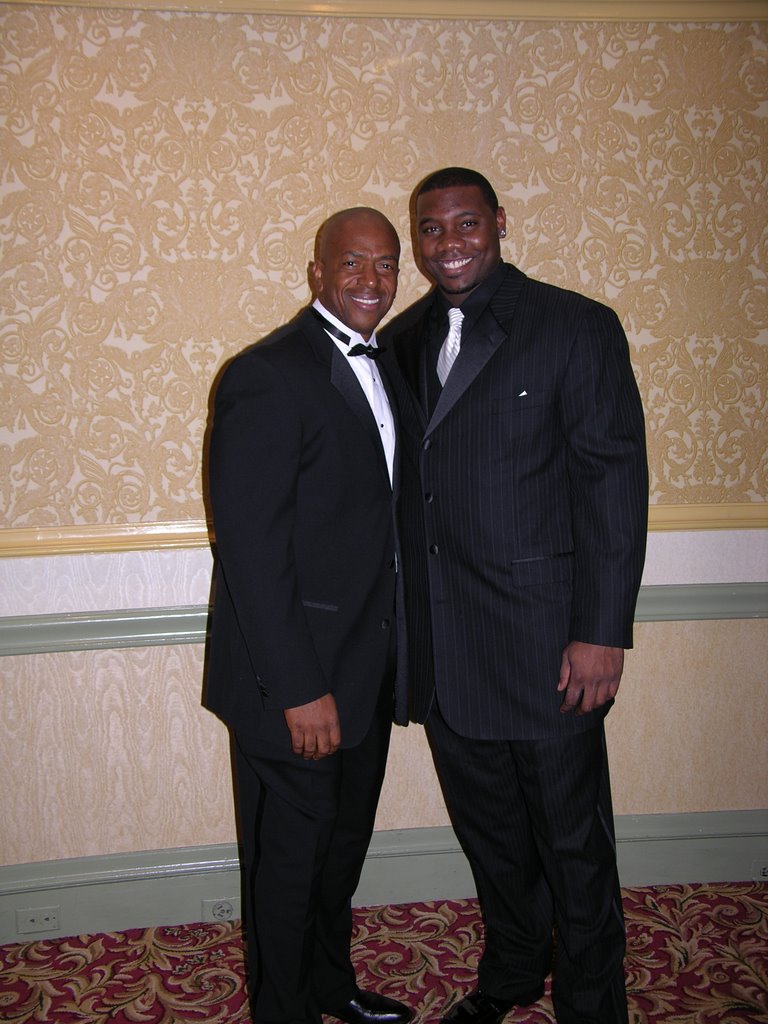 The Mets' ageless Julio Franco (left), winner of the New York chapter's Milton Richman You've Got To Have Heart Award, poses with Howard.
MVP Trophy completes Howard's Haul
NEW YORK - The Ryan Howard off-season awards tour is all but complete - as is the Phillies first baseman's haul from his MVP season.
On the night of Jan. 28, Howard rounded out his collection of hardware in style, officially receiving the Kenesaw Mountain Landis National League Most Valuable Player trophy, the award voted him by the Baseball Writers Association of America after his breakout 58-home run, 149-RBI campaign in 2006.
Surrounded by family, manager Charlie Manuel and a large contingent of Phillies front-office personnel, Howard was presented the plaque at the New York chapter of the Baseball Writers Association of America's 84th annual dinner by no less than Tony Gwynn, an outfielder who is scheduled for induction into the Hall of Fame this summer.
The youthful Phillies first baseman - flanked on the dais by the likes of Hall of Famers Frank Robinson, Reggie Jackson and the soon-to-be inducted Cal Ripken - was joined by his fellow 2006 BBWAA national award winners.
That group included managers of the year Jim Leyland of Detroit and Joe Girardi, formerly of the Florida Marlins; American League MVP Justin Morneau of the Minnesota Twins, rookies of the year Hanley Ramirez (Florida) and Justin Verlander (Detroit), and Cy Young Award winners Brandon Webb (Arizona) and Johan Santana (Minnesota).
"Truly an honor to be here," said Howard. "Last year, I never would have thought it. The company here - Tony Gwynn, Cal Ripken, Reggie Jackson - I've got to admit it, I'm still a fan and I am in awe."
The New York writers reserved a special place for Howard, making him the next-to-last recipient, followed only by Toast of the Town co-recipients Jose Reyes and David Wright.
Howard, previously honored this winter by writers in St. Louis and Boston, was afforded the best-supporting role by the New York writers thanks to his having won two awards. He was also given the New York chapter's Sid Mercer Award as player of the year. The latter is the second such honor for Howard in less than a week. Last Monday, he was feted as the Philadelphia Sports Writers Association's player of the year.
"I don't know if he'll get 58 home runs, again, but I tell what - I watched him practice, I watched him prepare," said Gwynn, who recalled Howard's work ethic when Howard traveled to California to practice with Gwynn's college baseball team at San Diego State University.
"For two days my guys sat there with their mouths open, not watching Ryan Howard hit with power, but watching Ryan Howard hit off a T. We were dumbfounded, the things he did with a baseball bat were truly amazing."
On the night of Jan. 28, Howard rounded out his collection of hardware in style, officially receiving the Kenesaw Mountain Landis National League Most Valuable Player trophy, the award voted him by the Baseball Writers Association of America after his breakout 58-home run, 149-RBI campaign in 2006.
Surrounded by family, manager Charlie Manuel and a large contingent of Phillies front-office personnel, Howard was presented the plaque at the New York chapter of the Baseball Writers Association of America's 84th annual dinner by no less than Tony Gwynn, an outfielder who is scheduled for induction into the Hall of Fame this summer.
The youthful Phillies first baseman - flanked on the dais by the likes of Hall of Famers Frank Robinson, Reggie Jackson and the soon-to-be inducted Cal Ripken - was joined by his fellow 2006 BBWAA national award winners.
That group included managers of the year Jim Leyland of Detroit and Joe Girardi, formerly of the Florida Marlins; American League MVP Justin Morneau of the Minnesota Twins, rookies of the year Hanley Ramirez (Florida) and Justin Verlander (Detroit), and Cy Young Award winners Brandon Webb (Arizona) and Johan Santana (Minnesota).
"Truly an honor to be here," said Howard. "Last year, I never would have thought it. The company here - Tony Gwynn, Cal Ripken, Reggie Jackson - I've got to admit it, I'm still a fan and I am in awe."
The New York writers reserved a special place for Howard, making him the next-to-last recipient, followed only by Toast of the Town co-recipients Jose Reyes and David Wright.
Howard, previously honored this winter by writers in St. Louis and Boston, was afforded the best-supporting role by the New York writers thanks to his having won two awards. He was also given the New York chapter's Sid Mercer Award as player of the year. The latter is the second such honor for Howard in less than a week. Last Monday, he was feted as the Philadelphia Sports Writers Association's player of the year.
"I don't know if he'll get 58 home runs, again, but I tell what - I watched him practice, I watched him prepare," said Gwynn, who recalled Howard's work ethic when Howard traveled to California to practice with Gwynn's college baseball team at San Diego State University.
"For two days my guys sat there with their mouths open, not watching Ryan Howard hit with power, but watching Ryan Howard hit off a T. We were dumbfounded, the things he did with a baseball bat were truly amazing."
Scenes From An Exhibition - Of Baseball Greats
Ryan Howard and father, Ronald, with Howard's Kenesaw Mountain Landis National League Most Valuable Player trophy presented to the Phillies first baseman at the New York chapter of the Baseball Writers Association of America's 84th annual dinner Jan. 28. Left to right, Mets manager Willie Randolph; Arlene Howard, wife of the late Elston Howard; Rachel Robinson, wife of the late Jackie Robinson; and Hall of Famer Frank Robinson, who was awarded the William J. Slocum Award for Long and Meritorious Service by the New York writers. The chapter also saluted Jackie Robinson's legacy, marking the 60th anniversary of the fall of the color barrier in Major League Baseball.
 Mets pitcher Tom Glavine, winner of the New York Writers' Ben Epstein "Good Guy" award (left), stands with Mets manager Willie Randolph and Mets team owner Fred Wilpon.
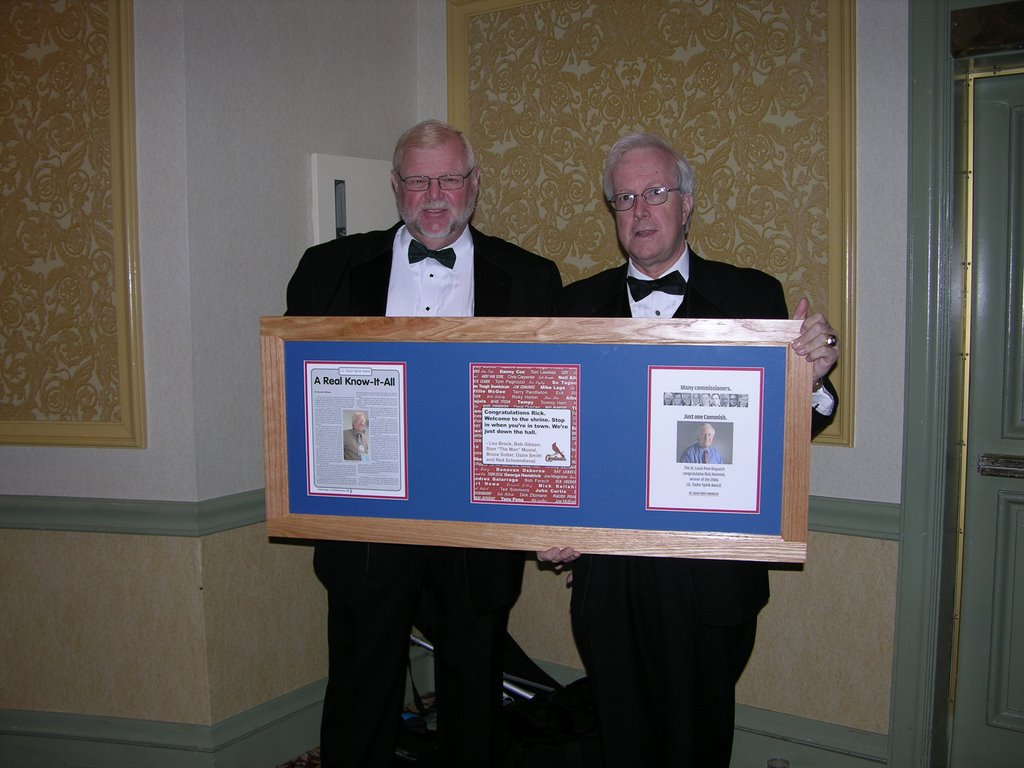 Marty Noble, veteran baseball columnist and the editor of the New York chapter's dinner magazine (left), presents the St. L0uis Post Dispatch's Rick Hummel with a framed compilation of the salutes to "The Commish's" pending enshrinement into Cooperstown. Hummel will enter the Hall of Fame as the 2006 J.G. Taylor Spink Award winner.
The Mets' ageless Julio Franco (left), winner of the New York chapter's Milton Richman You've Got To Have Heart Award, poses with Howard.
Thursday, January 25, 2007
Howard Patiently Awaiting Windfall
Ryan Howard last night accepted the Outstanding Professional Athlete Award from the Philadelphia Sports Writers Association, knowing full well that the monster numbers from 2006 that secured the honor will take a backseat to the numbers he will command at the bargaining table.
That much was assured when Howard awoke Sunday, the day after attending Chase Utley's California wedding, and learned his Phillies teammate had signed a seven-year, $85 million contract extension through 2013.
"I was happy for him," Howard told a news conference audience before the writers' 103d annual dinner last night at the Crowne Plaza Hotel in Cherry Hill. "That was a pretty good wedding gift. "
If Utley's good fortune or that of free agent Alfonso Soriano (who signed for eight years and $136 million with the Cubs) whetted Howard's appetite for a long-term deal, the National League MVP refused to let on.
Speculation? "I kind of leave that up to you guys," said the 27-year-old Howard, who set a franchise record with 58 home runs to go with 149 RBIs. "There's nothing that I can do about salaries or who's on the team. I don't make the decisions in the front office. What I can do is control what I do on the field. Until it happens, nothing's happened, so I don't worry about it. "
The Phillies have said that Howard's contract talks will not begin until their remaining arbitration-eligible players, pitchers Brett Myers and Geoff Geary, are signed.
When negotiations do begin with the first baseman, the Phillies have the leverage and could even stipulate a salary if the two sides do not agree. Howard is one season away from arbitration eligibility and will not be in line for free agency until 2011.
Even if the Phillies unilaterally renew his deal, Howard insists it will not knock the smile from his face. "I'm playing major-league baseball," he said, beaming. "I'm happy every day. "
He has noticed, however, that there is no such thing as a small development in the increasing limelight. Howard saw that when his recent change of agents caused a buzz. "It was just some differences, but it was handled," he said. "It's resolved. You just move on and go from there. "
As for honors such as last night's, Howard liberally applied grace, humor and humility. "You guys are the greatest," he told the sportswriters, laughing. Besides, said the onetime mass communications major at Southwest Missouri State, "I'm partly one of you guys. "
That much was assured when Howard awoke Sunday, the day after attending Chase Utley's California wedding, and learned his Phillies teammate had signed a seven-year, $85 million contract extension through 2013.
"I was happy for him," Howard told a news conference audience before the writers' 103d annual dinner last night at the Crowne Plaza Hotel in Cherry Hill. "That was a pretty good wedding gift. "
If Utley's good fortune or that of free agent Alfonso Soriano (who signed for eight years and $136 million with the Cubs) whetted Howard's appetite for a long-term deal, the National League MVP refused to let on.
Speculation? "I kind of leave that up to you guys," said the 27-year-old Howard, who set a franchise record with 58 home runs to go with 149 RBIs. "There's nothing that I can do about salaries or who's on the team. I don't make the decisions in the front office. What I can do is control what I do on the field. Until it happens, nothing's happened, so I don't worry about it. "
The Phillies have said that Howard's contract talks will not begin until their remaining arbitration-eligible players, pitchers Brett Myers and Geoff Geary, are signed.
When negotiations do begin with the first baseman, the Phillies have the leverage and could even stipulate a salary if the two sides do not agree. Howard is one season away from arbitration eligibility and will not be in line for free agency until 2011.
Even if the Phillies unilaterally renew his deal, Howard insists it will not knock the smile from his face. "I'm playing major-league baseball," he said, beaming. "I'm happy every day. "
He has noticed, however, that there is no such thing as a small development in the increasing limelight. Howard saw that when his recent change of agents caused a buzz. "It was just some differences, but it was handled," he said. "It's resolved. You just move on and go from there. "
As for honors such as last night's, Howard liberally applied grace, humor and humility. "You guys are the greatest," he told the sportswriters, laughing. Besides, said the onetime mass communications major at Southwest Missouri State, "I'm partly one of you guys. "
Wednesday, January 10, 2007
Truth Will Set Big Mac Free
As one of the 77 percent of the Baseball Writers Association voters who did not put Mark McGwire's name on my Hall of Fame ballot, I offer this open letter to the man who must feel his fall from grace is now complete, and irreversible:
Dear Mark:
I know you were routed in your initial battle to win inclusion in Baseball's Hall of Fame. That was bound to be the fate of the first big-name batter up for consideration from the steroid era.
Received only 23 percent of the necessary 75 percent of the votes needed for election had to be a stinging slap. But as much as it may have hurt, understand this, and understand it quickly: even though that battle was lost, you can still win the war, but only if you use the time left to you wisely, with the best interest of the game in mind.
You have 14 years to do so. That is the number of years of eligibility you still have left on the writers' ballots.
That decade and a half will seem like an interminable amount of time, but only if you view it as a painful period in which you are destined to twist slowly, endlessly on the outside of Cooperstown looking in.
But what if you go on the offensive, Mark?
Come clean about the steroid era, including any involvement you may have had in it. Then invite baseball to join in its version of a truth and reconciliation initiative of the sort that made a lasting peace possible in South Africa.
Nelson Mandela confirmed his genius and strengthened a nation. Can you help save a game?
Baseball, the national pastime, is worth saving. And it can only benefit from the kind of healing and cleansing that the truth about what drugs did to it and its records can bring.
Lives may not be at stake, just reputations such as yours are; that was brought home with brutal force Monday when your bid for immortality was rebuked, and infamy was offered, instead.
Now you know: Baseball is a game that depends on reputations - and heroes - unlike any other. Yet your one saving grace could be that if there's anything baseball fans, and people in the country as a whole, love more than a hero it is a repentant hero.
Pete Rose has never understood that. He's yet to accept the fact that three simple words - "I am sorry" would not only bring forgiveness for his gambling indiscretions. They would bring down the walls that keep him barred from the game, from the Hall to this day.
So be smarter, and less self-destructive than Rose, Mark. Be the first to show him the way. Don't continue to relegate steroids to a past you refuse to speak on. Blow the lid off the era and let the air, and light in.
Then dare others, from Barry Bonds to the other countless number of players who also know the truth to follow your lead.
Do that and you will prove that not only were your home runs powerful, but so, too, is your desire to heal the game. Then, and only then, will you have a chance to be judged truly Hall-worthy.
Dear Mark:
I know you were routed in your initial battle to win inclusion in Baseball's Hall of Fame. That was bound to be the fate of the first big-name batter up for consideration from the steroid era.
Received only 23 percent of the necessary 75 percent of the votes needed for election had to be a stinging slap. But as much as it may have hurt, understand this, and understand it quickly: even though that battle was lost, you can still win the war, but only if you use the time left to you wisely, with the best interest of the game in mind.
You have 14 years to do so. That is the number of years of eligibility you still have left on the writers' ballots.
That decade and a half will seem like an interminable amount of time, but only if you view it as a painful period in which you are destined to twist slowly, endlessly on the outside of Cooperstown looking in.
But what if you go on the offensive, Mark?
Come clean about the steroid era, including any involvement you may have had in it. Then invite baseball to join in its version of a truth and reconciliation initiative of the sort that made a lasting peace possible in South Africa.
Nelson Mandela confirmed his genius and strengthened a nation. Can you help save a game?
Baseball, the national pastime, is worth saving. And it can only benefit from the kind of healing and cleansing that the truth about what drugs did to it and its records can bring.
Lives may not be at stake, just reputations such as yours are; that was brought home with brutal force Monday when your bid for immortality was rebuked, and infamy was offered, instead.
Now you know: Baseball is a game that depends on reputations - and heroes - unlike any other. Yet your one saving grace could be that if there's anything baseball fans, and people in the country as a whole, love more than a hero it is a repentant hero.
Pete Rose has never understood that. He's yet to accept the fact that three simple words - "I am sorry" would not only bring forgiveness for his gambling indiscretions. They would bring down the walls that keep him barred from the game, from the Hall to this day.
So be smarter, and less self-destructive than Rose, Mark. Be the first to show him the way. Don't continue to relegate steroids to a past you refuse to speak on. Blow the lid off the era and let the air, and light in.
Then dare others, from Barry Bonds to the other countless number of players who also know the truth to follow your lead.
Do that and you will prove that not only were your home runs powerful, but so, too, is your desire to heal the game. Then, and only then, will you have a chance to be judged truly Hall-worthy.
Subscribe to:
Posts (Atom)