The National Baseball Hall of Fame and Museum will honor the largest - and perhaps the last - class elected from the ranks of Negro League baseball.
Buck O'Neil will not be among the luminaries selected from black baseball. But the legendary manager of the Kansas City Monarchs of the old Negro American League will be there.
His attendance, alone, is a testament to a gracious man and speaks to baseball's good fortune that he is part of the game.
Never a slash-and-burn militant, O'Neil never showed bitterness about the era in which he was denied an opportunity to play in the majors because of segregation. Nor has he shown bitterness about his continuing to be excluded from Cooperstown.
O'Neil could have latched onto the controversy that arose when when a special committee recommended 17 Negro League-era players, managers and owners be enshrined, but did not include him. Many, many others did. Players, members of the media, historians, even Hall of Famers.
O'Neil, like always, left the vitriol to others. By doing so, he remains what he long ago became - the thoughtful public face of an important, often troubling period in American history.
So when he addresses the assembly that gathers to honor the Hall's Class of 2006, give him an extra round of applause. For Buck O'Neil may not yet be enshrined in Cooperstown, but he is a Hall of Famer in every other sense of the phrase.
Tuesday, July 25, 2006


Thursday, July 20, 2006
The Agony and the Ecstasy: The Sequel
In the 1965 movie, The Agony and the Ecstasy, Michelangelo has an on-running exchange with Pope Julius II about his seemingly endless tinkering with a little paint job called the Sistine Chapel.
Pope Julius, portrayed by Rex Harrison, kept asking where there would be a finish to which Mick, ie. Charlton Heston would respond it would be done when he was done.
Back and forth they went, alternating trigger words. Something along the lines of "when will there be a finish? When I am done. ... When will it be done? When I am finished."
Think Barry Bonds knows how Pope Julius felt?
I mean, waiting for the federal government to do something, anything to determine if the slugger is going to the slammer for steroid abuse/perjury/tax evasion/passing Babe Ruth's 714-home run total/being ill-mannered has become worse than a war of attrition.
It's like watching paint dry.
Today, the feds revealed that they are not done. But they also gave no clue as to when there will be a finish.
Instead, the feds who have been investigating Bonds, his tax returns, his truthiness - or lack thereof - in previous testimony about alleged steroid use, declined to indict Bonds. But they also declined to say they wouldn't indict him somewhere down the line.
What the feds will do is seat a new grand jury in order to keep on, well, keeping on. The new panel's obviously thankless chore? Determining if Bonds' bad taste in trainers, chemists and mistresses and love affair with the long ball are criminal - something the previous grand jury did not and apparently could not do.
Chances are the only people happy with this turn of events yesterday were the jurists whose grand jury assignment mercifully expired.
For them, there finally was an end.
For Bonds, baseball and the feds? There is no finish yet. Only the certain knowledge that not matter how this all finally plays out, no timeless work of art will be the result. Just a scandal that will rank among the game's biggest, dirtiest and most embarrassing of all time.
Pope Julius, portrayed by Rex Harrison, kept asking where there would be a finish to which Mick, ie. Charlton Heston would respond it would be done when he was done.
Back and forth they went, alternating trigger words. Something along the lines of "when will there be a finish? When I am done. ... When will it be done? When I am finished."
Think Barry Bonds knows how Pope Julius felt?
I mean, waiting for the federal government to do something, anything to determine if the slugger is going to the slammer for steroid abuse/perjury/tax evasion/passing Babe Ruth's 714-home run total/being ill-mannered has become worse than a war of attrition.
It's like watching paint dry.
Today, the feds revealed that they are not done. But they also gave no clue as to when there will be a finish.
Instead, the feds who have been investigating Bonds, his tax returns, his truthiness - or lack thereof - in previous testimony about alleged steroid use, declined to indict Bonds. But they also declined to say they wouldn't indict him somewhere down the line.
What the feds will do is seat a new grand jury in order to keep on, well, keeping on. The new panel's obviously thankless chore? Determining if Bonds' bad taste in trainers, chemists and mistresses and love affair with the long ball are criminal - something the previous grand jury did not and apparently could not do.
Chances are the only people happy with this turn of events yesterday were the jurists whose grand jury assignment mercifully expired.
For them, there finally was an end.
For Bonds, baseball and the feds? There is no finish yet. Only the certain knowledge that not matter how this all finally plays out, no timeless work of art will be the result. Just a scandal that will rank among the game's biggest, dirtiest and most embarrassing of all time.
Managing his mouth off
From my notebook to today's Philadelphia Inquirer...
NEW YORK - Ozzie Guillen, holed up in his South Florida home, was as angry as he'd ever been, so much so that the man who aspired to manage in the majors was about to quit baseball. For good.
The year was 2003 and Guillen, then the Florida Marlins' third-base coach, was fuming because the team had just fired its manager and his mentor, Jeff Torborg.
Guillen, going so far as to order the clubhouse staff to pack his belongings and ship them home, was through - that is, until the man who had managed him as a player and given him his first coaching job telephoned to ask one burning question:
"What are you doing?' " Torborg demanded. "You can't quit, Oz. You're going to manage one day!"
How right he was.
Guillen, who didn't quit, not only is one of baseball's most successful managers - he led the Chicago White Sox to a World Series crown a year ago in just his second season. The former shortstop from Venezuela also is one of the game's most provocative.
Unapologetically outspoken and combative, at times both profane and politically incorrect - that's Ozzie Guillen on a quiet day.
Mix the always-ready-to-tap emotions with situations in which he simply cannot resist shouting the unvarnished truth, and Guillen, 42, becomes one of the biggest characters and outspoken quote machines in the game.
If you think this "can't miss" entertainment from the 2005 AL manager of the year is something on nightly television highlight reels, imagine the view from the dugout.
As White Sox designated hitter Jim Thome wryly told reporters at the All-Star Game last week in Pittsburgh: "It's a lot of fun on his bench."
Sometimes the fire that is Guillen singes. That's OK, he says.
"I don't expect anybody to like me," Guillen said before his team played at Yankee Stadium Saturday. "I expect them to respect me and play for me."
The Sox, who had been without a World Series title since 1917, certainly have played for him: The 2005 world championship was won with an 11-1 run through the postseason. Much the same cast owns baseball's second-highest winning percentage despite suspect pitching this season.
As for liking him...
"He's different than what the media make him out to be," A.J. Pierzynski said. "I'm not going to say there haven't been run-ins, but the players like coming here every day and like playing for him."
The reason is simple, the all-star catcher said: "He treats his players as something special. He knows how to deal with everyone, communicate with everyone."
Just not always with a velvet touch, right?
"Well, he's not even-keel," Pierzynski said with a smile. "He does get emotional. But he doesn't change. He brings the same energy every day, win or lose.
"When he gets upset, he tells you, puts it behind him, and moves on. Sure, sometimes it's told in the newspapers, but often, when it is, you've already ironed it out and gotten it out of the way, and that's great."
Such a clearing of the air may have been in order before the White Sox ended their three-game weekend series here against the Yankees. Guillen, just off his stint as manager of the American League all-stars, was asked Saturday why he had chosen to use Yankees closer Mariano Rivera to save the AL comeback victory last week in Pittsburgh instead of his own bulldog closer, Bobby Jenks.
Rivera "is the best in the history of baseball," Guillen said Saturday, the day before Rivera nailed down career save No. 400 at Chicago's expense.
And if Jenks wasn't quite OK with that?
"I don't care if he's OK with it," Guillen said, defiance ringing in his voice. "I'm the manager. I'm the one that makes the moves. If he don't like it, play for someone else."
Guillen then laughed, as did the reporters he was addressing, a reminder that the package is complete only when the rapier wit is revealed.
That doesn't mean that serious missteps don't occur. They often do when a personality is in perpetual overdrive.
Earlier this season, Guillen, in full rant, used a homophobic phrase to describe a Chicago-based columnist to reporters. For that he was reprimanded by baseball commissioner Bud Selig and ordered to undergo sensitivity training.
A day after slurring the writer, Guillen said: "The word I used, I should have used something different. A lot of people's feelings were hurt, and I didn't mean it that way." Then, choosing different words, he unleashed another profanity-spiced opinion of the writer.
On Saturday, Guillen suggested that the incident was nothing personal, and was blown a bit out of proportion because of who he is. Still, he said, "that story was not the media's fault. It was my fault."
Torborg had predicted there would be such moments during a 2003 telephone conversation with Jerry Reinsdorf, the White Sox team owner for whom he had once managed. And that was during a call he made to recommend his former star shortstop and White Sox team captain as a manager.
"I told Jerry, there's no question about his work ethic, his knowledge, his enthusiasm, his love for the game, or his ability to communicate," Torborg said. "But I said, 'You will have to possibly be making some apologies for some of the things he says!' "
Reinsdorf laughed and so did Torborg. But the conversation did not end.
"I told Jerry that Ozzie is so honest; that's why he is so good with the players," Torborg said. "They know where he's coming from.
"And he won't put up with not playing hard or playing the right way. He'll get in their faces, no matter where - on the field, in the dugout, in the middle of the clubhouse. Then, the next thing you know, he's got his arm around the guy, taking him out to dinner... unbelievable!"
And absolute.
"I'm never going to change," Guillen vowed Saturday. "One thing about me - I'm always going to say the truth."
NEW YORK - Ozzie Guillen, holed up in his South Florida home, was as angry as he'd ever been, so much so that the man who aspired to manage in the majors was about to quit baseball. For good.
The year was 2003 and Guillen, then the Florida Marlins' third-base coach, was fuming because the team had just fired its manager and his mentor, Jeff Torborg.
Guillen, going so far as to order the clubhouse staff to pack his belongings and ship them home, was through - that is, until the man who had managed him as a player and given him his first coaching job telephoned to ask one burning question:
"What are you doing?' " Torborg demanded. "You can't quit, Oz. You're going to manage one day!"
How right he was.
Guillen, who didn't quit, not only is one of baseball's most successful managers - he led the Chicago White Sox to a World Series crown a year ago in just his second season. The former shortstop from Venezuela also is one of the game's most provocative.
Unapologetically outspoken and combative, at times both profane and politically incorrect - that's Ozzie Guillen on a quiet day.
Mix the always-ready-to-tap emotions with situations in which he simply cannot resist shouting the unvarnished truth, and Guillen, 42, becomes one of the biggest characters and outspoken quote machines in the game.
If you think this "can't miss" entertainment from the 2005 AL manager of the year is something on nightly television highlight reels, imagine the view from the dugout.
As White Sox designated hitter Jim Thome wryly told reporters at the All-Star Game last week in Pittsburgh: "It's a lot of fun on his bench."
Sometimes the fire that is Guillen singes. That's OK, he says.
"I don't expect anybody to like me," Guillen said before his team played at Yankee Stadium Saturday. "I expect them to respect me and play for me."
The Sox, who had been without a World Series title since 1917, certainly have played for him: The 2005 world championship was won with an 11-1 run through the postseason. Much the same cast owns baseball's second-highest winning percentage despite suspect pitching this season.
As for liking him...
"He's different than what the media make him out to be," A.J. Pierzynski said. "I'm not going to say there haven't been run-ins, but the players like coming here every day and like playing for him."
The reason is simple, the all-star catcher said: "He treats his players as something special. He knows how to deal with everyone, communicate with everyone."
Just not always with a velvet touch, right?
"Well, he's not even-keel," Pierzynski said with a smile. "He does get emotional. But he doesn't change. He brings the same energy every day, win or lose.
"When he gets upset, he tells you, puts it behind him, and moves on. Sure, sometimes it's told in the newspapers, but often, when it is, you've already ironed it out and gotten it out of the way, and that's great."
Such a clearing of the air may have been in order before the White Sox ended their three-game weekend series here against the Yankees. Guillen, just off his stint as manager of the American League all-stars, was asked Saturday why he had chosen to use Yankees closer Mariano Rivera to save the AL comeback victory last week in Pittsburgh instead of his own bulldog closer, Bobby Jenks.
Rivera "is the best in the history of baseball," Guillen said Saturday, the day before Rivera nailed down career save No. 400 at Chicago's expense.
And if Jenks wasn't quite OK with that?
"I don't care if he's OK with it," Guillen said, defiance ringing in his voice. "I'm the manager. I'm the one that makes the moves. If he don't like it, play for someone else."
Guillen then laughed, as did the reporters he was addressing, a reminder that the package is complete only when the rapier wit is revealed.
That doesn't mean that serious missteps don't occur. They often do when a personality is in perpetual overdrive.
Earlier this season, Guillen, in full rant, used a homophobic phrase to describe a Chicago-based columnist to reporters. For that he was reprimanded by baseball commissioner Bud Selig and ordered to undergo sensitivity training.
A day after slurring the writer, Guillen said: "The word I used, I should have used something different. A lot of people's feelings were hurt, and I didn't mean it that way." Then, choosing different words, he unleashed another profanity-spiced opinion of the writer.
On Saturday, Guillen suggested that the incident was nothing personal, and was blown a bit out of proportion because of who he is. Still, he said, "that story was not the media's fault. It was my fault."
Torborg had predicted there would be such moments during a 2003 telephone conversation with Jerry Reinsdorf, the White Sox team owner for whom he had once managed. And that was during a call he made to recommend his former star shortstop and White Sox team captain as a manager.
"I told Jerry, there's no question about his work ethic, his knowledge, his enthusiasm, his love for the game, or his ability to communicate," Torborg said. "But I said, 'You will have to possibly be making some apologies for some of the things he says!' "
Reinsdorf laughed and so did Torborg. But the conversation did not end.
"I told Jerry that Ozzie is so honest; that's why he is so good with the players," Torborg said. "They know where he's coming from.
"And he won't put up with not playing hard or playing the right way. He'll get in their faces, no matter where - on the field, in the dugout, in the middle of the clubhouse. Then, the next thing you know, he's got his arm around the guy, taking him out to dinner... unbelievable!"
And absolute.
"I'm never going to change," Guillen vowed Saturday. "One thing about me - I'm always going to say the truth."
Foaming About Froemming
Phillies fans really responded to a recent package I wrote about umpire Bruce Froemming, who is approaching his 5,000th major-league game. One went so far as to day Froemming's call in Game 3 of the National League Championship Series between the Los Angeles Dodgers and the Phillies at a packed Veterans Stadium on Oct. 7, 1977, "ruined" his life.
"Tell Bruce that the next time you talk to him," the loyal reader said.
Just goes to show that baseball is the sport built on personalities - and how those personalities transcend time and keep even the most fleeting moments alive and well for years, if not decades, in the hearts and minds of the fan.
To read why Froemming still raises the blood pressure of Phillies fans, click on the above link. To read about his great career - 36 years in the majors, 12 in the minors, click on Bruce Froemming's story.
"Tell Bruce that the next time you talk to him," the loyal reader said.
Just goes to show that baseball is the sport built on personalities - and how those personalities transcend time and keep even the most fleeting moments alive and well for years, if not decades, in the hearts and minds of the fan.
To read why Froemming still raises the blood pressure of Phillies fans, click on the above link. To read about his great career - 36 years in the majors, 12 in the minors, click on Bruce Froemming's story.
Sunday, July 16, 2006
Wild Insinuation
Derek Jeter looked like something had literally been lost in the translation.
Someone had actually suggested that the Yankees had to win the American League East to advance to the 2006 postseason since everyone was saying that the wildcard berth will obviously go to a team from another division.
"I don't know who's been saying that. I haven't been saying that," the Yankees' shortstop said Saturday.
Afterall, he said, the Yankees were four games back of the front-running Chicago White Sox in the AL wild-card standings after winning the first two games of their three-game series at Yankee Stadium. Jeter said that with 70-some games left, that four-game difference was not enough.
"You can't just punch a team's ticket and say the wild card is coming out of here, or this team is automatically in the playoffs. Four games with 70 some games left? I don't think that's too big of a lead."
Thing is, Jeter isn't really thinking about the wild card as a vehicle to help the Yankees extend their decade-long postseason streak alive. "We want to win the division," said this 10-year vet who's never not played in the postseason.
Yankees-Red Sox. That does have more of a ring to it than Yankees-White Sox.
Someone had actually suggested that the Yankees had to win the American League East to advance to the 2006 postseason since everyone was saying that the wildcard berth will obviously go to a team from another division.
"I don't know who's been saying that. I haven't been saying that," the Yankees' shortstop said Saturday.
Afterall, he said, the Yankees were four games back of the front-running Chicago White Sox in the AL wild-card standings after winning the first two games of their three-game series at Yankee Stadium. Jeter said that with 70-some games left, that four-game difference was not enough.
"You can't just punch a team's ticket and say the wild card is coming out of here, or this team is automatically in the playoffs. Four games with 70 some games left? I don't think that's too big of a lead."
Thing is, Jeter isn't really thinking about the wild card as a vehicle to help the Yankees extend their decade-long postseason streak alive. "We want to win the division," said this 10-year vet who's never not played in the postseason.
Yankees-Red Sox. That does have more of a ring to it than Yankees-White Sox.
Saturday, July 15, 2006
Saw This Freight Train Coming
The Detroit Tigers, possessors of the best record in baseball, might be the surprise of the year to most people.
Not Ozzie Guillen. The manager of the defending world champion Chicago White Sox saw this freight train coming at his team in the American League Central two years ago.
"Back in spring training, even last year, too, I said the team that is going to give problems is the Detroit Tigers," Guillen said today at Yankee Stadium. "When you looked at their pitching in 2004, looked at their pitching, you knew they were going to be good in a couple of years. Then, when the general manager [Dave Dombrowski] got the job, I said, watch, the Detroit Tigers in a couple years, they're going to win.
"Because, if you know Dave, he will do anything in his power to put a good ballclub together."
Dombrowski, Tigers GM since 2002, has put a string of gems together on offense and defense when he acquired free-agent catcher Ivan Rodriguez, shortstop Carlos Guillen and centerfielder Curtis Granderson.
Still, the difference-maker is the Tigers' pitching - and Dombrowski's prints are all over this very artistic rendering, much the same way they were on the two world championship teams he crafted for the Florida Marlins in 1997 and 2001.
He engineered the trade for Jeremy Bonderman in 2002. Justin virulently was came into the organization on Dombrowski's watch as a first-round pick in baseball's amateur draft of 2004. Those two starting pitchers are a combined 19-8 going into today's games.
Young reliever Joel Zumaya, a valuable setup man for veteran stopper Todd Jones (24 saves) was a plum Dombrowski's people found in 11th round in '02. And he found another, most surprising morsel on the free agent market in the form of veteran starter Kenny Rogers.
People scratched their heads when Dombrowski spent $16 million on a two-year deal for the 41-year-old pitcher. But Rogers' second straight All-star selection - and the starting assignment for the American League last week in Pittsburgh, combined with an 11-3 record, quieted doubters.
Add veteran manager Jim Leyland to the mix and the Detroit Tigers become a poignant as well as a plausible success story.
Most important, thanks to Dombrowski, they are no longer a doormat but rather armed, dangerous and poised to continue as baseball's winningest team. One poised to fulfill the grudgingly admiring Guillen's worst fears.
Not Ozzie Guillen. The manager of the defending world champion Chicago White Sox saw this freight train coming at his team in the American League Central two years ago.
"Back in spring training, even last year, too, I said the team that is going to give problems is the Detroit Tigers," Guillen said today at Yankee Stadium. "When you looked at their pitching in 2004, looked at their pitching, you knew they were going to be good in a couple of years. Then, when the general manager [Dave Dombrowski] got the job, I said, watch, the Detroit Tigers in a couple years, they're going to win.
"Because, if you know Dave, he will do anything in his power to put a good ballclub together."
Dombrowski, Tigers GM since 2002, has put a string of gems together on offense and defense when he acquired free-agent catcher Ivan Rodriguez, shortstop Carlos Guillen and centerfielder Curtis Granderson.
Still, the difference-maker is the Tigers' pitching - and Dombrowski's prints are all over this very artistic rendering, much the same way they were on the two world championship teams he crafted for the Florida Marlins in 1997 and 2001.
He engineered the trade for Jeremy Bonderman in 2002. Justin virulently was came into the organization on Dombrowski's watch as a first-round pick in baseball's amateur draft of 2004. Those two starting pitchers are a combined 19-8 going into today's games.
Young reliever Joel Zumaya, a valuable setup man for veteran stopper Todd Jones (24 saves) was a plum Dombrowski's people found in 11th round in '02. And he found another, most surprising morsel on the free agent market in the form of veteran starter Kenny Rogers.
People scratched their heads when Dombrowski spent $16 million on a two-year deal for the 41-year-old pitcher. But Rogers' second straight All-star selection - and the starting assignment for the American League last week in Pittsburgh, combined with an 11-3 record, quieted doubters.
Add veteran manager Jim Leyland to the mix and the Detroit Tigers become a poignant as well as a plausible success story.
Most important, thanks to Dombrowski, they are no longer a doormat but rather armed, dangerous and poised to continue as baseball's winningest team. One poised to fulfill the grudgingly admiring Guillen's worst fears.
Thursday, July 13, 2006
From Jackie Robinson to ... Ryan Howard?
Could it be that the Philadelphia Phillies will finally produce their first bona fide black superstar?
That is, a superstar in the sense of bigger-than-life personality so widely accepted, marketable and beloved that he not only could be the centerpiece of a franchise, but a bridge to a still-elusive fan segment — and untapped revenue source — the black Philadelphia.
Ryan Howard, the 2005 rookie of the year and powerful first baseman who won baseball’s home-run hitting contest during the All-star celebration this month, could be that player.
Howard’s shoulders seem that broad, his heart seems that willing, his sense of the mission to promote something larger than himself seems right on.
In Pittsburgh, Howard went toe-to-toe with the Mets’ vibrant shooting star, David Wright, in the finale of the nationally televised derby. And he not only held his own at the plate but also in the Q ratings.
His luminous smile and personality lit up the Pittsburgh skyline, all but defying anyone not to include him in the next generation of marketable baseball stars.
That night Howard said on national TV that his home-run derby win finally gave the Phillies — one of the major disappointments of the 2006 season — something to cheer about.
He also gave the organization more evidence that he just might finally be the guy the Phillies can count on to close a gap that has existed since, well, 1947.
That’s the year Jackie Robinson broke baseball’s color barrier and became baseball’s first ambassador to black America. And black America responded, welcoming and worshipping the heroic figure who helped the game shed, at long last, its segregation policies. One by one, most every major league team reinvented Robinson in the form of their own homegrown superstar players of color.
Larry Doby in Cleveland. Henry Aaron in Milwaukee/Atlanta. Willie Mays in New York/San Francisco. Ernie Banks and Billy Williams in Chicago. Joe Morgan in Cincinnati. Frank Robinson in Cincy and Baltimore. Willie Stargell and Roberto Clemente in Pittsburgh.
Even St. Louis, the seat of rebellion against Robinson in ’47, eventually gave us Bob Gibson and Lou Brock.
The Phillies? They neither couldn’t or wouldn’t plug that caliber of superstar into their mosaic. And that gaping hole assured to this day that the Phillies’ major contribution to the story of baseball and race remains the fact that Philadelphia was the one stop most hostile to Robinson in ’47.
That legacy, and the lack of a major black presence in Phillies’ history is why I contend blacks in Philadelphia remain indifferent, even suspicious, of the franchise to this day. Al Downing, who grew up in Trenton and went on the pitch for the Yankees and Dodgers, agreed with that perception in a conversation long ago. When with L.A., Downing also noticed how few black fans turned out. And those who did came to root for the Dodgers.
Jackie’s team.
That allegiance, Downing contended, directly resulted from the Phillies never having given black Philadelphians someone to replace Robinson in their hearts. Not that there weren’t Phillies of color.
Richie Allen was a talent, to be sure, but one who often played the role of the angry black man — not so popular in blue-collar Philly during the racially volatile 1960s.
Sad fact is, Philadelphia never got Richie Allen. And the moody Allen never got Philly. And it cost Allen, who should have gotten much more of a bounce, popularity-wise, given his enormous talents.
Then there was the introspective Garry Maddox. A class act, Maddox often did more in one month, community-relations wise, than some 25-man rosters did in a season.But Maddox was quiet and introspective. And, to borrow a phrase from Reggie Jackson, Maddox was never seen as “the straw that stirred” the winning Phillies’ teams of the 70s and 80s. Not with Hall of Famers Mike Schmidt and Steve Carlton, pepperpot shortstop Larry Bowa and Dallas Green, the larger-than-life manager of the Phillies’ 1980 championship team, around.
Tony Taylor? Oscar Gamble? Gary Matthews? Davey Cash? Good citizens and good players, all. But they, too, played in the shadows of larger stars.
Of the current Phillies, Jimmy Rollins seemed on the cusp of being the breakthrough guy, but the ebb and flow of his game often seem to conspire to keep the shortstop and town at arm’s length from each other. Rollins is more willing to step up than, say Pat Burrell or Bobby Abreu. But to be a Frank Robinson, Pops Stargell or Ernie Banks requires not just talent, but a larger-than-life presence that never shrinks from the spotlight.
Jackie Robinson has waited a long time to hand off the baton to such a figure here.
Ryan Howard, it’s there for the taking. Grab it and go the distance.
That is, a superstar in the sense of bigger-than-life personality so widely accepted, marketable and beloved that he not only could be the centerpiece of a franchise, but a bridge to a still-elusive fan segment — and untapped revenue source — the black Philadelphia.
Ryan Howard, the 2005 rookie of the year and powerful first baseman who won baseball’s home-run hitting contest during the All-star celebration this month, could be that player.
Howard’s shoulders seem that broad, his heart seems that willing, his sense of the mission to promote something larger than himself seems right on.
In Pittsburgh, Howard went toe-to-toe with the Mets’ vibrant shooting star, David Wright, in the finale of the nationally televised derby. And he not only held his own at the plate but also in the Q ratings.
His luminous smile and personality lit up the Pittsburgh skyline, all but defying anyone not to include him in the next generation of marketable baseball stars.
That night Howard said on national TV that his home-run derby win finally gave the Phillies — one of the major disappointments of the 2006 season — something to cheer about.
He also gave the organization more evidence that he just might finally be the guy the Phillies can count on to close a gap that has existed since, well, 1947.
That’s the year Jackie Robinson broke baseball’s color barrier and became baseball’s first ambassador to black America. And black America responded, welcoming and worshipping the heroic figure who helped the game shed, at long last, its segregation policies. One by one, most every major league team reinvented Robinson in the form of their own homegrown superstar players of color.
Larry Doby in Cleveland. Henry Aaron in Milwaukee/Atlanta. Willie Mays in New York/San Francisco. Ernie Banks and Billy Williams in Chicago. Joe Morgan in Cincinnati. Frank Robinson in Cincy and Baltimore. Willie Stargell and Roberto Clemente in Pittsburgh.
Even St. Louis, the seat of rebellion against Robinson in ’47, eventually gave us Bob Gibson and Lou Brock.
The Phillies? They neither couldn’t or wouldn’t plug that caliber of superstar into their mosaic. And that gaping hole assured to this day that the Phillies’ major contribution to the story of baseball and race remains the fact that Philadelphia was the one stop most hostile to Robinson in ’47.
That legacy, and the lack of a major black presence in Phillies’ history is why I contend blacks in Philadelphia remain indifferent, even suspicious, of the franchise to this day. Al Downing, who grew up in Trenton and went on the pitch for the Yankees and Dodgers, agreed with that perception in a conversation long ago. When with L.A., Downing also noticed how few black fans turned out. And those who did came to root for the Dodgers.
Jackie’s team.
That allegiance, Downing contended, directly resulted from the Phillies never having given black Philadelphians someone to replace Robinson in their hearts. Not that there weren’t Phillies of color.
Richie Allen was a talent, to be sure, but one who often played the role of the angry black man — not so popular in blue-collar Philly during the racially volatile 1960s.
Sad fact is, Philadelphia never got Richie Allen. And the moody Allen never got Philly. And it cost Allen, who should have gotten much more of a bounce, popularity-wise, given his enormous talents.
Then there was the introspective Garry Maddox. A class act, Maddox often did more in one month, community-relations wise, than some 25-man rosters did in a season.But Maddox was quiet and introspective. And, to borrow a phrase from Reggie Jackson, Maddox was never seen as “the straw that stirred” the winning Phillies’ teams of the 70s and 80s. Not with Hall of Famers Mike Schmidt and Steve Carlton, pepperpot shortstop Larry Bowa and Dallas Green, the larger-than-life manager of the Phillies’ 1980 championship team, around.
Tony Taylor? Oscar Gamble? Gary Matthews? Davey Cash? Good citizens and good players, all. But they, too, played in the shadows of larger stars.
Of the current Phillies, Jimmy Rollins seemed on the cusp of being the breakthrough guy, but the ebb and flow of his game often seem to conspire to keep the shortstop and town at arm’s length from each other. Rollins is more willing to step up than, say Pat Burrell or Bobby Abreu. But to be a Frank Robinson, Pops Stargell or Ernie Banks requires not just talent, but a larger-than-life presence that never shrinks from the spotlight.
Jackie Robinson has waited a long time to hand off the baton to such a figure here.
Ryan Howard, it’s there for the taking. Grab it and go the distance.
Saturday, July 08, 2006
Things we never saw coming
- Cubs pitcher Kerry Wood, who was on the disabled list three times last year and missed the 1999 season after elbow surgery, is back on the DL because of a partial tear in his right rotator cuff. Surgery might be in order. In the least he's out a month. If he's cut, again, he's gone for the season. Staff ace going down with such an injury means just one thing in Chicago, of course - Cubs manager Dusty Baker's IQ just dropped, again.
- Jose Canseco is writing yet another tell-all about steroid use in Major League Baseball, vowing to name more names in his effort to convince baseball fans that its Baseball's Club Medicine Cabinet had more than one member. Oh, yeah, the guys he named in his last expose, Juiced, never did sue for libel. What's up with that, Mark McGwire, Rafael Palmeiro and Co.?
- Manny Ramirez who, on Friday, bowed out of the upcoming All-star game because of a sore knee, doubled twice, hit a single and drew a walk in the Boston Red Sox win over the Chicago White Sox Saturday.
Wednesday, July 05, 2006
Dusty in Trouble. Of Course.
It is absolutely amazing how the Chicago Cubs can dumb down a manager.
Both Dusty Baker and Don Baylor - the last two Cubs' managers not considered interim - brought manager of the year credentials with them to the Windy City. Oddly, neither could figure out a couple things - how to keep players like Kerry Wood, Mark Prior, Bill Mueller, Nomar Garciaparra, etc., on the field (should have had MD degrees instead of manager of the year plaques, I guess).
Nor could Dusty keep an otherwise sophisticated city from fixating on one fan interference play in the 2003 NLCS series loss to the Florida Marlins - and equating that bit of bad luck to his managing ability.
Let's see, what did he do wrong in '03? Baker had the Cubs' two top pitchers (Prior and Wood), set up to pitch Games 6 and 7 against the Fish. The Cubs were up, 3-0, and within five outs of their first World Series since 1945 when fan Steve Bartman flagged a foul ball hit in the stands rather than let leftfielder Moises Alou reach in to snare the ball. Alou freaked. The Cubs fans immediately went into their best woe-is-us, we're doomed imitation of the persecuted act perfected by Boston Red Sox fans.
Forget the fact that the team had an ace in hand - Wood. Chicago moaned, groaned before and after a Game 7 loss. Never mind that the Marlins - the eventual world champs - were a pretty darned good team. Baker had officially transformed from coveted manager/genius to village idiot. He never was allowed a shot at redemption. Couldn't overcome Bartman, the breastbeating fans nor the fact that he has never, ever been able to count on having the injury-prone Prior and Wood as a 1-2 punch for any length of time, since.
What a dope!
But don't worry, Dusty. If and when the Cubs fire you, your IQ will improve in direct proportion to the distance you put between youself and the city of Big Shoulders - and Bigger Second Guessers. Get on with your life, and leave the Cubbies' fans to cry in their beer while wishing their team could figure it out like the White Sox - the defending champion White Sox - did. Who knows. Maybe some of the Cubs' fans have MDs. Maybe they can fix broke-down pitchers and all else that ails this terminally underachieving franchise.
It is absolutely amazing how the Chicago Cubs can dumb down a manager.
Both Dusty Baker and Don Baylor - the last two Cubs' managers not considered interim - brought manager of the year credentials with them to the Windy City. Oddly, neither could figure out a couple things - how to keep players like Kerry Wood, Mark Prior, Bill Mueller, Nomar Garciaparra, etc., on the field (should have had MD degrees instead of manager of the year plaques, I guess).
Nor could Dusty keep an otherwise sophisticated city from fixating on one fan interference play in the 2003 NLCS series loss to the Florida Marlins - and equating that bit of bad luck to his managing ability.
Let's see, what did he do wrong in '03? Baker had the Cubs' two top pitchers (Prior and Wood), set up to pitch Games 6 and 7 against the Fish. The Cubs were up, 3-0, and within five outs of their first World Series since 1945 when fan Steve Bartman flagged a foul ball hit in the stands rather than let leftfielder Moises Alou reach in to snare the ball. Alou freaked. The Cubs fans immediately went into their best woe-is-us, we're doomed imitation of the persecuted act perfected by Boston Red Sox fans.
Forget the fact that the team had an ace in hand - Wood. Chicago moaned, groaned before and after a Game 7 loss. Never mind that the Marlins - the eventual world champs - were a pretty darned good team. Baker had officially transformed from coveted manager/genius to village idiot. He never was allowed a shot at redemption. Couldn't overcome Bartman, the breastbeating fans nor the fact that he has never, ever been able to count on having the injury-prone Prior and Wood as a 1-2 punch for any length of time, since.
What a dope!
But don't worry, Dusty. If and when the Cubs fire you, your IQ will improve in direct proportion to the distance you put between youself and the city of Big Shoulders - and Bigger Second Guessers. Get on with your life, and leave the Cubbies' fans to cry in their beer while wishing their team could figure it out like the White Sox - the defending champion White Sox - did. Who knows. Maybe some of the Cubs' fans have MDs. Maybe they can fix broke-down pitchers and all else that ails this terminally underachieving franchise.
Monday, July 03, 2006
True journalist at work
Stepping away from baseball a moment, let me tell you about Jon Pessah, my former editor at The Hartford Courant.
Jon taught me and so many others so much about being a good reporter with the emphasis on professionalism and the honoring of the craft. He still does teach, and lead by example; witness the outstanding work Jon and a staff of writers did last fall in an eye-opening series on the roots of the steroid scandal in baseball published last fall in ESPN, The Magazine.
Now Jon is doing the reporting, on the allegations of rape at Duke and the scandals ramifications for the university and the surrounding community, for ESPN, The Magazine, and ESPN.com.
It's a story that has everything, and will eventually go a long way in narrating America's next chapters on race, class, privilege and the media's approach to sensational stories.
If you want to see it interpreted well, check out Jon's work, beginning with his article on ex-Duke lacrosse player Matt Zash of the Philadelphia Barrage. I did - because I will always want to continue to see one of the good guys - and great journalist - do this job the right way.
Stepping away from baseball a moment, let me tell you about Jon Pessah, my former editor at The Hartford Courant.
Jon taught me and so many others so much about being a good reporter with the emphasis on professionalism and the honoring of the craft. He still does teach, and lead by example; witness the outstanding work Jon and a staff of writers did last fall in an eye-opening series on the roots of the steroid scandal in baseball published last fall in ESPN, The Magazine.
Now Jon is doing the reporting, on the allegations of rape at Duke and the scandals ramifications for the university and the surrounding community, for ESPN, The Magazine, and ESPN.com.
It's a story that has everything, and will eventually go a long way in narrating America's next chapters on race, class, privilege and the media's approach to sensational stories.
If you want to see it interpreted well, check out Jon's work, beginning with his article on ex-Duke lacrosse player Matt Zash of the Philadelphia Barrage. I did - because I will always want to continue to see one of the good guys - and great journalist - do this job the right way.
Sunday, July 02, 2006
Talk radio
At 3 p.m., July 1, 1987, WFAN the nation's first 24-7 sports talk radio station, went on the air in New York City - and sports coverage hasn't been the same since.
The change has often been detrimental to the newspaper industry, thanks to the pressure to mimmick in print the shrill, voice that never lets issues run a natural course, burn bright, then die out.
Instead, as former major league manager Jeff Torborg once said, controversies just keep going on and on, 24-7, as commentators, working in "three-hour shifts," to quote Torborg, beat issues to death in order to fill air time.
That said, let me add that here on the NY-NJ-PA. corridor, WFAN remains without peer. Its imidators are just that, and poor ones, at best. In Philadelphia, the WIP crew makes WFAN's roster seem Pulitzer Prize-worthy as they presume to be the stars that drive sports. Though WFAN's hosts are celebrities even by New York standards, they allow the sports, the athletes and coaches they cover remain the station's primary focus.WFAN talks to the likes of Larry Brown, Joe Torre and pro athletes from around the world.
Other stations who eschew the "guest" spot, too often prefer to mock the pro games and players - and fellow members of the media, often from the safety of their studio desks. Feel free to read that as an apt description of WIP in Philadelphia, if you will.
Though some of WFAN's on-air personalities are more famous than others, special kudos are reserved here for Steve Somers, a very witty on-air commentator who never stoops to insulting or carving up his callers, sports fans or the teams and athletes he covers. Wish they could clone him and franchise him out to the stations that still do a lot of talking without really understanding what "talk radio" should be about.
At 3 p.m., July 1, 1987, WFAN the nation's first 24-7 sports talk radio station, went on the air in New York City - and sports coverage hasn't been the same since.
The change has often been detrimental to the newspaper industry, thanks to the pressure to mimmick in print the shrill, voice that never lets issues run a natural course, burn bright, then die out.
Instead, as former major league manager Jeff Torborg once said, controversies just keep going on and on, 24-7, as commentators, working in "three-hour shifts," to quote Torborg, beat issues to death in order to fill air time.
That said, let me add that here on the NY-NJ-PA. corridor, WFAN remains without peer. Its imidators are just that, and poor ones, at best. In Philadelphia, the WIP crew makes WFAN's roster seem Pulitzer Prize-worthy as they presume to be the stars that drive sports. Though WFAN's hosts are celebrities even by New York standards, they allow the sports, the athletes and coaches they cover remain the station's primary focus.WFAN talks to the likes of Larry Brown, Joe Torre and pro athletes from around the world.
Other stations who eschew the "guest" spot, too often prefer to mock the pro games and players - and fellow members of the media, often from the safety of their studio desks. Feel free to read that as an apt description of WIP in Philadelphia, if you will.
Though some of WFAN's on-air personalities are more famous than others, special kudos are reserved here for Steve Somers, a very witty on-air commentator who never stoops to insulting or carving up his callers, sports fans or the teams and athletes he covers. Wish they could clone him and franchise him out to the stations that still do a lot of talking without really understanding what "talk radio" should be about.
Suzyn Waldman, Pioneer
When WFAN first went on the air on that July 1, 1987, the first voice heard was that of Suzyn Waldman.
A strong, brave woman in the often unforgiving male-dominated environments of media and professional sports, Suzyn has perservered, more than holding her own in the toughest media town in the nation.
A former Broadway musical star, Suzyn remains a headliner and trailblazer in second distinct career, serving as a color commentator for the New York Yankees on that team's radio broadcasts. She is only the second woman to ever hold such a position in Major League Baseball (the first was Betty Caywood of the Kansas City A's in the 1960s, according to wikipedia.com).
Suzyn was the first woman to do play-by-play on televised Major League games when, in the mid-1990s, she worked Yankees games on that team's local broadcasts. She remains the only woman with that distinction.
So, on a personal note, it always has been and continues to be a privilege to work with Suzyn. It is not easy to often be one of the precious few, if not the only woman in the male bastions of the Major League press box or pro clubhouse or locker room. I have seen Suzyn not only survive, but thrive as we lived through such things as the World Series earthquake in 1989 or navigated the treacherous waters surrounding the Yankees beat in the 1980s and 1990s.
So when you think about Suzyn, think about more than just the journalist who won the 1996 NY Sportscaster of the Year, by The National Sportscasters and Sportswriters, and the American Women in Radio and TV's Star Award for Radio in 1999, the WFAN and Yankees' broadcast pioneer.
Think about the grace, the professionalism and the courage. These are the core of the legacy still being artfully written by Suzyn Waldman to this day.
A strong, brave woman in the often unforgiving male-dominated environments of media and professional sports, Suzyn has perservered, more than holding her own in the toughest media town in the nation.
A former Broadway musical star, Suzyn remains a headliner and trailblazer in second distinct career, serving as a color commentator for the New York Yankees on that team's radio broadcasts. She is only the second woman to ever hold such a position in Major League Baseball (the first was Betty Caywood of the Kansas City A's in the 1960s, according to wikipedia.com).
Suzyn was the first woman to do play-by-play on televised Major League games when, in the mid-1990s, she worked Yankees games on that team's local broadcasts. She remains the only woman with that distinction.
So, on a personal note, it always has been and continues to be a privilege to work with Suzyn. It is not easy to often be one of the precious few, if not the only woman in the male bastions of the Major League press box or pro clubhouse or locker room. I have seen Suzyn not only survive, but thrive as we lived through such things as the World Series earthquake in 1989 or navigated the treacherous waters surrounding the Yankees beat in the 1980s and 1990s.
So when you think about Suzyn, think about more than just the journalist who won the 1996 NY Sportscaster of the Year, by The National Sportscasters and Sportswriters, and the American Women in Radio and TV's Star Award for Radio in 1999, the WFAN and Yankees' broadcast pioneer.
Think about the grace, the professionalism and the courage. These are the core of the legacy still being artfully written by Suzyn Waldman to this day.
Friday, June 30, 2006
These Sons Have Got Game, Too
On June 18, The Inquirer ran a list of all the sons of former major league players and/or officials who were selected in the June Draft. A reader wrote to correct two oversights, saying: "You can add Stephen Puhl, Mets,17th round, son of Terry. Also Shane Byrne, Diamondbacks, 5th round, grandson of Tommy Byrne, the Yankees LHP who was 16-5 in 1955. These boys played in the Atlantic Collegiate Baseball League."
Consider it done.
On June 18, The Inquirer ran a list of all the sons of former major league players and/or officials who were selected in the June Draft. A reader wrote to correct two oversights, saying: "You can add Stephen Puhl, Mets,17th round, son of Terry. Also Shane Byrne, Diamondbacks, 5th round, grandson of Tommy Byrne, the Yankees LHP who was 16-5 in 1955. These boys played in the Atlantic Collegiate Baseball League."
Consider it done.
Philly - the 6th Boro and hating it
One of the main reasons why the Phillies no longer reserve the right to even think "wild card" was that short stretch in June in which they allowed Philadelphia to live up to its nickname "The Sixth Borough."
In one nine-game homestand, the Phillies lost five of six to the New York Mets and New York Yankees, getting treated with less respect than a Manhattanite pays Staten Island.
The team from Queens was especially tough on the Phillies, sweeping three games to increase its lead in the National League East over the Fightins' from 6 1/2 games to 9 1/2.
Not that the Mets couldn't have done it without them, but the Phillies made the visitors look an awful lot like the 1998 Yankees - that near-perfect team that won a total of 125 games - regular- and postseason - en route to World Series championship.
The Mets outscored Philadelphia, 23-14, in those three games - 7-0 in the first innings, alone! They never trailed at any point in the series.
Like that '98 Yankees team, the Mets are filled with hitters who display patience and an understanding that the guy next to him in the lineup can get it done if the pitches are worthy of swinging at. That deepens a lineup - and makes it deadlier.
The Mets' baserunning was also so aggressive the likes of Jose Reyes seemed to move at fast-forward speed compared to the bumbling Phillies, and it forced Phillies' misplay after misplay.
That pedal-to-the-medal mentality throughout the three games was a tribute to Mets manager Willie Randolph, a "National League"-style player even though he spent nearly his entire playing career in the American League.
Earlier in the season Yankees manager Joe Torre paid his fellow manager and former coach as high a compliment as there is when he said the Mets "play the way Willie did."
Hamels Impresses Yankees
Just because Cole Hamels isn't piling up victories doesn't mean he isn't leaving some good first impressions. The lefthander threw a solid seven innings at the Yankees -- giving up just two runs on six hits with six strikeouts in a 5-0 lossto New York on June 21.
Said Yankees manager Joe Torre: "Very impressed. ... He had a great deal of poise, threw the changeup at will. But we knew coming in he was pretty good.
Said Johnny Damon: "[Coming in] we had no idea what he threw. We realized that he throws a cutter and has a good curve ball. And he has good poise out there. He also throws hard for a lefty and that's an added bonus. I feel that with a little work and as he builds up his legs, he may be able to go out there and throw a little harder as he matures.
Said Jason Giambi: "He throws harder than Barry Zito. He has a great young arm. He wouldn't throw me a fastball, except out of the strike zone. He has a great changeup and throws it for a strike, so it's hard to eliminate pitches when he was throwing all of them for strikes."
... Alex Rodriguez: "Good stuff, very impressive. He's got a great future."
And Derek Jeter: "He threw well. I only got one change and it was on a hit-and-run. But it looks like he has good control of it."
"Wild card:" four-letter words to some
Thoughts of a wild card berth aren't coarsing through the minds of the Phillies any more. Fact, is, who knows what those guys are thinking. ...
But for all those teams starting to think in terms of the wild card, a word of advice from veteran pitcher Tom Glavine: Don't.
"I can only tell you from my experiences from my years in Atlanta - we wanted to win our division, period.," said the presumptive Hall of Fame pitcher who's helped pitch the current Mets to the top of the NL East.
"That was our goal," Glavine said of the Braves' 1990s dynasty. "That is what we wanted. If something else happened, you deal with it and you accept it. But, our goal, even in years when we found ourselves behind, it wasn't about, 'well, we still have the wild card and we'll fall back on that.
"You're going to do what you can do to win the division and if you can't, then you accept the wild card. But that was never our goal."
Glavine also cautions against the catch phrases that signal surrender and suggest that so-called contenders deep down inside know they're just pretenders. Phrases such as "he's a youngster and it is good to get him some experience in the major leagues," or "we're just treading water until our injured players come back," or "we're waiting for those guys [the team being chased] to come back to us."
"That's not sending a real ringing endorsement on your thoughts of you chances of really doing something," said Glavine. "I mean, you have to believe you have a chance to do something, whether you're the team in first place or in second place. If you're in one of those positions you're in contention. And if you're in contention, you're in contention for a reason - and that's usually because you have talent.
"Bottom line: if you're in contention, you're there for a reason - and you have to believe in those reasons why you're there."
One of the main reasons why the Phillies no longer reserve the right to even think "wild card" was that short stretch in June in which they allowed Philadelphia to live up to its nickname "The Sixth Borough."
In one nine-game homestand, the Phillies lost five of six to the New York Mets and New York Yankees, getting treated with less respect than a Manhattanite pays Staten Island.
The team from Queens was especially tough on the Phillies, sweeping three games to increase its lead in the National League East over the Fightins' from 6 1/2 games to 9 1/2.
Not that the Mets couldn't have done it without them, but the Phillies made the visitors look an awful lot like the 1998 Yankees - that near-perfect team that won a total of 125 games - regular- and postseason - en route to World Series championship.
The Mets outscored Philadelphia, 23-14, in those three games - 7-0 in the first innings, alone! They never trailed at any point in the series.
Like that '98 Yankees team, the Mets are filled with hitters who display patience and an understanding that the guy next to him in the lineup can get it done if the pitches are worthy of swinging at. That deepens a lineup - and makes it deadlier.
The Mets' baserunning was also so aggressive the likes of Jose Reyes seemed to move at fast-forward speed compared to the bumbling Phillies, and it forced Phillies' misplay after misplay.
That pedal-to-the-medal mentality throughout the three games was a tribute to Mets manager Willie Randolph, a "National League"-style player even though he spent nearly his entire playing career in the American League.
Earlier in the season Yankees manager Joe Torre paid his fellow manager and former coach as high a compliment as there is when he said the Mets "play the way Willie did."
Hamels Impresses Yankees
Just because Cole Hamels isn't piling up victories doesn't mean he isn't leaving some good first impressions. The lefthander threw a solid seven innings at the Yankees -- giving up just two runs on six hits with six strikeouts in a 5-0 lossto New York on June 21.
Said Yankees manager Joe Torre: "Very impressed. ... He had a great deal of poise, threw the changeup at will. But we knew coming in he was pretty good.
Said Johnny Damon: "[Coming in] we had no idea what he threw. We realized that he throws a cutter and has a good curve ball. And he has good poise out there. He also throws hard for a lefty and that's an added bonus. I feel that with a little work and as he builds up his legs, he may be able to go out there and throw a little harder as he matures.
Said Jason Giambi: "He throws harder than Barry Zito. He has a great young arm. He wouldn't throw me a fastball, except out of the strike zone. He has a great changeup and throws it for a strike, so it's hard to eliminate pitches when he was throwing all of them for strikes."
... Alex Rodriguez: "Good stuff, very impressive. He's got a great future."
And Derek Jeter: "He threw well. I only got one change and it was on a hit-and-run. But it looks like he has good control of it."
"Wild card:" four-letter words to some
Thoughts of a wild card berth aren't coarsing through the minds of the Phillies any more. Fact, is, who knows what those guys are thinking. ...
But for all those teams starting to think in terms of the wild card, a word of advice from veteran pitcher Tom Glavine: Don't.
"I can only tell you from my experiences from my years in Atlanta - we wanted to win our division, period.," said the presumptive Hall of Fame pitcher who's helped pitch the current Mets to the top of the NL East.
"That was our goal," Glavine said of the Braves' 1990s dynasty. "That is what we wanted. If something else happened, you deal with it and you accept it. But, our goal, even in years when we found ourselves behind, it wasn't about, 'well, we still have the wild card and we'll fall back on that.
"You're going to do what you can do to win the division and if you can't, then you accept the wild card. But that was never our goal."
Glavine also cautions against the catch phrases that signal surrender and suggest that so-called contenders deep down inside know they're just pretenders. Phrases such as "he's a youngster and it is good to get him some experience in the major leagues," or "we're just treading water until our injured players come back," or "we're waiting for those guys [the team being chased] to come back to us."
"That's not sending a real ringing endorsement on your thoughts of you chances of really doing something," said Glavine. "I mean, you have to believe you have a chance to do something, whether you're the team in first place or in second place. If you're in one of those positions you're in contention. And if you're in contention, you're in contention for a reason - and that's usually because you have talent.
"Bottom line: if you're in contention, you're there for a reason - and you have to believe in those reasons why you're there."
Tuesday, June 27, 2006
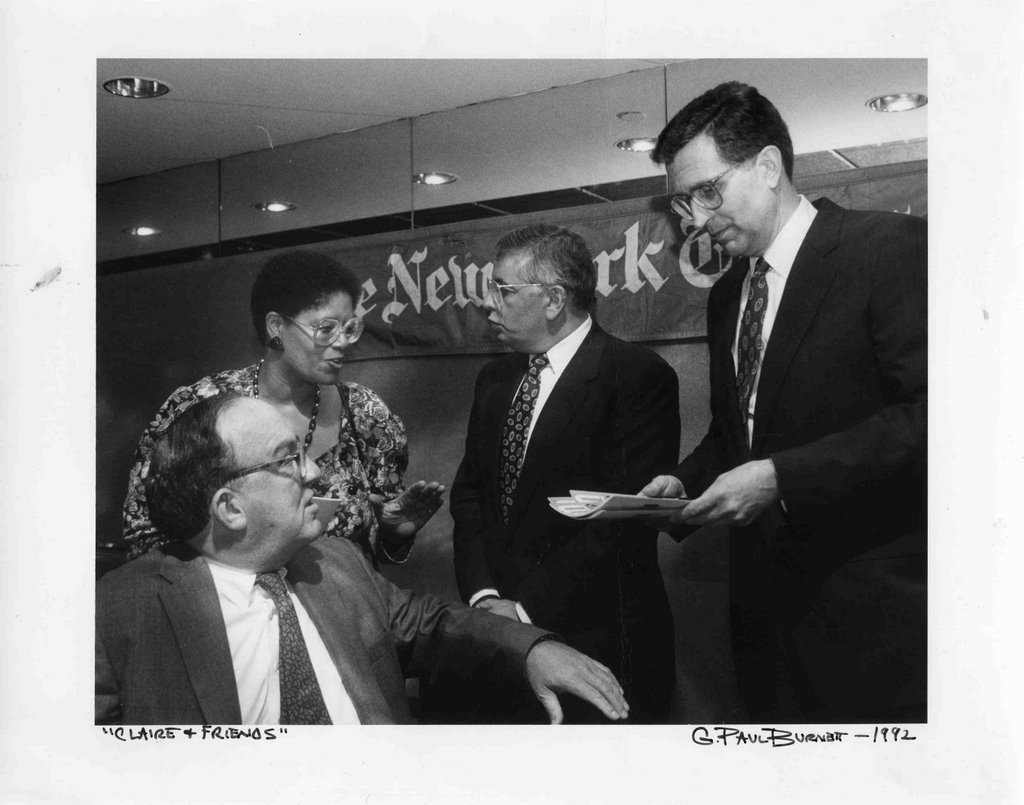
******Stops Along The Way. The Commissioners' Summitt,
at the AWSM Convention, New York, 1992. Standing: NBA's
David Stern (l) and NFL's Paul Tagliabue. Seated: Fay
Vincent of Baseball. Fay takes a backseat to no one
when it comes to the love of The Summer Game. No one. *******
***Cito Gaston, Dusty Baker and Don Baylor -
Managers of the Year who were a privilege to
cover. Baseball will be a better place when Don
Baylor, a phenomenal baseball presence, gets back in the game. ***
Class of the Junior Set
Wasn't it only yesterday that a teenaged Ken Griffey Jr. used to walk into the Yankee Stadium clubhouse, sidle up to his father and chirp "How was your day, Dad. ... I had a pretty good day."
Junior is still having pretty good days. Tonight he hit his 550th career homer. No. 549, hit on Sunday, allowed Junior to pass Mike Schmidt and took over 11th place on the career list. Next up is Reggie Jackson, No. 10 with 563.
No. 55o was also Junior's 152d as a Cincinnati Red, tying Pete Rose and Joe Morgan for 12th place on that franchise's all-time home run list. Johnny Bench holds the club record, with 389 homers.
Now, Ken Griffey Sr. was a pretty neat player, himself. But the son, well, just by the company Junior is keeping on both lists - Hall of Famers, all - suggests Junior will be settling in at Cooperstown about five years after he takes his last swing. He is a Hall of Famer, thanks to a powerful lot of pretty good days in the Major Leagues.
Wasn't it only yesterday that a teenaged Ken Griffey Jr. used to walk into the Yankee Stadium clubhouse, sidle up to his father and chirp "How was your day, Dad. ... I had a pretty good day."
Junior is still having pretty good days. Tonight he hit his 550th career homer. No. 549, hit on Sunday, allowed Junior to pass Mike Schmidt and took over 11th place on the career list. Next up is Reggie Jackson, No. 10 with 563.
No. 55o was also Junior's 152d as a Cincinnati Red, tying Pete Rose and Joe Morgan for 12th place on that franchise's all-time home run list. Johnny Bench holds the club record, with 389 homers.
Now, Ken Griffey Sr. was a pretty neat player, himself. But the son, well, just by the company Junior is keeping on both lists - Hall of Famers, all - suggests Junior will be settling in at Cooperstown about five years after he takes his last swing. He is a Hall of Famer, thanks to a powerful lot of pretty good days in the Major Leagues.
That's An Apology?
Today, pitcher Brett Myers and the Phillies organization issued a statement saying that Myers will take a leave of absence at least through the All-Star break in order to deal with the ramifications of his weekend arrest on assault charges against his wife.
Does Myers finally get the implications of his actions that allegedly left his wife, Kim, beaten and crying on a Boston street?
You judge.
“First, while I dispute that the facts are as alleged, I recognize that my behavior was inappropriate and for that I apologize,” Myers said in the statement. “Second, I recognize that the incident created an embarrassing situation for many people, including my wife and family, my teammates, the Phillies organization, and fans, and Iam very sorry for that.”
Second big question - do the Phillies get it? After all, the team had to receive a thorough pasting in the court of public opinion to decide it had any opinion at all on the Myers situation. Previously the Phillies' only comment was through their actions, which included a club decision to let their ace pitch one day after his arrest and arraignment.
Today the team issued a formal statement.
Said team president Dave Montgomery: “We have been engaged in a difficult balancing of concerns for the rights of our employee, the presumption ofinnocence, the rights of his spouse, and the legitimate public concern about allegations of spousal abuse by aPhillies ballplayer. We believe that the present status, including a publicapology by Brett Myers, time off from baseball, professional assistance for Brett and Kim Myers, and this statement achieves the appropriate balance for now.”
Appropriate balance? Not really. But it's a start. The truly important step will come when the Phillies throw the full weight of their influence behind any movement designed to eliminate the culture of domestic violence from society as a whole - and from the lifestyle of any young man or woman they employ.
Does Myers finally get the implications of his actions that allegedly left his wife, Kim, beaten and crying on a Boston street?
You judge.
“First, while I dispute that the facts are as alleged, I recognize that my behavior was inappropriate and for that I apologize,” Myers said in the statement. “Second, I recognize that the incident created an embarrassing situation for many people, including my wife and family, my teammates, the Phillies organization, and fans, and Iam very sorry for that.”
Second big question - do the Phillies get it? After all, the team had to receive a thorough pasting in the court of public opinion to decide it had any opinion at all on the Myers situation. Previously the Phillies' only comment was through their actions, which included a club decision to let their ace pitch one day after his arrest and arraignment.
Today the team issued a formal statement.
Said team president Dave Montgomery: “We have been engaged in a difficult balancing of concerns for the rights of our employee, the presumption ofinnocence, the rights of his spouse, and the legitimate public concern about allegations of spousal abuse by aPhillies ballplayer. We believe that the present status, including a publicapology by Brett Myers, time off from baseball, professional assistance for Brett and Kim Myers, and this statement achieves the appropriate balance for now.”
Appropriate balance? Not really. But it's a start. The truly important step will come when the Phillies throw the full weight of their influence behind any movement designed to eliminate the culture of domestic violence from society as a whole - and from the lifestyle of any young man or woman they employ.
Death in The Bulletin Family
Scattered across America there is a wonderful extended family of former Philadelphia Bulletin reporters and editors. Those who worked in the sports department up until the moment the newspaper folded in 1982 remain particularly close. So I know my friends and Bulletin "family" are all mourning the loss of John T. "Jack" Wilson, retired Bulletin sports editor and good friend who passed away Thursday at age 85.
Jack will be buried today, with a military honor guard befitting a decorated World War II veteran.
Rest well, my friend and know that nearly everyone still misses The Bulletin. We miss you, too.
Monday, June 26, 2006
Assault, Battery & Embarrassment
Glum times in Philadelphia, and it has very little to do with baseball.
The Phillies are in a freefall - understandable since this is a a team no one really figured to be around in October.
What is troubling is the club's reaction, or lack thereof, to the arrest of pitcher Brett Myers for alledgedly beating his wife in the early morning hours of June 25 in Boston.
What was reported to Boston police by witnesses who placed multiple 911 calls sounded like a brutal beatdown, something that demanded immediate, forceful action by Myers' employers regarding a) the pitcher's immediate status, b) steps to be taken to send a message of zero-tolerance for violent perpetrators within the organization and c) something, anything that suggested that Kim Myers had as much support from the Phillies' "family" as did the staff ace.
To date, the Phillies have chosen not to lend their public voice to the first two categories and as for Kim Myers, well ... She didn't get anything in the way of a public apology let alone a show of contriteness from her husband. What did he get? The ball and his regular start in the rotation one day after he was bailed out of jail.
In other words, it was business as usual as far as the Phillies are concerned. No time for outreach to the community to explain the organization's stance on domestic violence. No time to say, "hey, we get it. We understand that kids are watching our players, seeking to be like our big-leaguers, learning about actions, consequences, the law and what is right or just flatout wrong."
No time to do the right thing.
The perceived lack of sensitivity to this alleged savage act unleashed a fury among fans.
Good.
It is simply not acceptable in this day and age that the Phillies think it is good enough that they pretty much limited their responses to Myers' arrest whether he had the wherewithal to take the mound hours after being arrested, or whether his legal troubles might prove to be a distraction to the team.
No sensible soul cared about the so-called distraction any more than they cared to see Myers on the mound ever again until he shows some remorse about what happened on that grim evening in Boston.
The Phillies are in a freefall - understandable since this is a a team no one really figured to be around in October.
What is troubling is the club's reaction, or lack thereof, to the arrest of pitcher Brett Myers for alledgedly beating his wife in the early morning hours of June 25 in Boston.
What was reported to Boston police by witnesses who placed multiple 911 calls sounded like a brutal beatdown, something that demanded immediate, forceful action by Myers' employers regarding a) the pitcher's immediate status, b) steps to be taken to send a message of zero-tolerance for violent perpetrators within the organization and c) something, anything that suggested that Kim Myers had as much support from the Phillies' "family" as did the staff ace.
To date, the Phillies have chosen not to lend their public voice to the first two categories and as for Kim Myers, well ... She didn't get anything in the way of a public apology let alone a show of contriteness from her husband. What did he get? The ball and his regular start in the rotation one day after he was bailed out of jail.
In other words, it was business as usual as far as the Phillies are concerned. No time for outreach to the community to explain the organization's stance on domestic violence. No time to say, "hey, we get it. We understand that kids are watching our players, seeking to be like our big-leaguers, learning about actions, consequences, the law and what is right or just flatout wrong."
No time to do the right thing.
The perceived lack of sensitivity to this alleged savage act unleashed a fury among fans.
Good.
It is simply not acceptable in this day and age that the Phillies think it is good enough that they pretty much limited their responses to Myers' arrest whether he had the wherewithal to take the mound hours after being arrested, or whether his legal troubles might prove to be a distraction to the team.
No sensible soul cared about the so-called distraction any more than they cared to see Myers on the mound ever again until he shows some remorse about what happened on that grim evening in Boston.
Saturday, June 24, 2006
The following is an article I wrote for the June 18 Sunday Philadelphia Inquirer.
Diamonds also a father's (and son's) best friend'
Like father, like son' carries onto the baseball diamondDoug Drabek, dear old Dad, has taught his son Kyle a lot.
By Claire Smith
INQUIRER STAFF WRITER
Former major-league pitcher Doug Drabek knows that is what people think when they see his son Kyle on the mound. Same build. Same shock of sandy blond hair. The onetime Cy Young Award winner also sees the same stuff. Not just spitting-image fastballs, but stuff - the fire in the belly, the refusal to lose.
"He's got his own thing - his own delivery, his own motion, and maybe he throws harder," Doug Drabek said. "But we both are both so competitive. He doesn't want to ever lose - just like me."
Baseball, intrigued by both the nature and nurture in the relationship between fathers and sons, is dipping into gene pools more than ever in search of second- and third-generation players. The Phillies certainly did when they selected Kyle Drabek in the first round of the draft, making the hard-throwing chip off the old block the 18th pick overall.
Drabek was not unique. Father's Day came early for 20 former major-leaguers when their sons were drafted on June 6 and 7.
Kyle Drabek, for one, knows he registered with scouts in part because of his dad. "He's been an inspiration to me all my life," the 18-year-old from The Woodlands, Texas, said. "In a way, my dad's always been teaching me about life. And, as a pitcher, he taught me everything I know."
Like many major-leaguers, Doug was happy just to be able to give Kyle and Justin - 13 months Kyle's senior - access to his world. It is part of the routine: sons and daughters of big-leaguers rollicking around ballparks in baggy baseball uniforms and floppy caps, playing make-believe on the field, in dugouts, in Dad's locker, all while the big guys watch over them - and dream.
"When they were younger, sure you hope they will play - that that would be neat," Doug said. "But you wonder, too, what if they lose the flavor for the game?
"Then I'd think about what I got from my dad. He coached me, but he never forced me to play. He taught me that as long as you have good kids, let them be what they want to be."
What did his kids want? "When they were smaller, they just kind of wanted to play with the other kids around the clubhouse," he said. "Then, by the time I got to Houston [in 1993], they started to get to know some of the players."
That's when the added benefits famed sons such as Ken Griffey Jr. and Barry Bonds speak of began to factor in. "By the time they were 12," Doug, 43, recalled, being around big-leaguers "was more of an advantage because the boys were into baseball more. They were in situations where being around clubhouses allowed them to get comfortable with the setting. "
Some of Kyle's most vivid memories are not of surroundings, but of the man who won 155 games. "When you're younger, just being able to be around him at the ballpark, you watch, you learn so much," Kyle said. "I can remember everyone saying, 'When he's on the mound, he hates to lose.' He was always so aggressive out there."
When Drabek's 13-year career ended in 1998, he embraced life at home with his wife, Kristy, and his children, including his daughter, Kelsey, 14.
"I wanted to be around them, wanted them to know I was available for them," he said. So Drabek poured himself into coaching - though he laughingly admitted that "I can't help my daughter with cheerleading or dance."
But he could help Kyle and Justin. So he coached the aspiring pitchers part-time and full-time, from Little League on, even turning down a minor-league coaching job to do so.
"He's always been there for us," Kyle said.
Doug Drabek's approach was simple: "Let them have fun." It was also caring, Kyle said. "When I was young, he told me to throw nothing but fastballs because he didn't want me to hurt my arm," he said. The other pitches - and inside-baseball stuff - would come later, in measured doses.
"Once I saw their style and their approach, I pretty much left them alone - if nothing was wrong," Doug said. "Maybe I'd see something in the delivery, or the way they threw a certain pitch, and I'd say something."
It hasn't always been easy. Having a major-league last name has often brought out the worst in fans. Kyle also had a personal Web page defaced by hackers.
"I probably take stuff like that worse than he does, because I'm a dad," Doug said. Yet Kyle's composure is his father, because, the son said, "Dad knew how to keep his cool on and off the field.
"It's pretty hard to describe, the bond between us three," Kyle said. "And baseball has always been such a big part of it."
Now, as Justin still strives to join a big-league organization, Kyle, his 14-0 senior season over and a high school state title won, knows he is almost there. "I'll be on my own in many ways," he said, "but my dad will still be teaching me things, about on the field and off - because he's lived it."
Nature and nurture. Like baseball, Kyle Drabek is banking on both.
Contact staff writer Claire Smith at 215-854-0454 or smithc@phillynews.com.
All in the Family Sons of major-leaguers taken in the 2006 draft:
Kyle Drabek, Phillies, first round, son of Doug.
Preston Mattingly, Dodgers, compensation round, son of Don.
Chad Tracy, Rangers, third round, son of Pirates manager Jim.
Marcus Lemon, Rangers, fourth round, son of Chet.
John Shelby, White Sox, fifth round, son of John.
Joshua Lansford, Cubs, sixth round, son of Carney.
Tyree Hayes, Devil Rays, eighth round, son of Charlie.
Jeremy Barfield, Mets, ninth round, son of Jesse.
Joshua Roenicke, Reds, 10th round, son of Gary.
Benjamin Petralli, Tigers, 17th round, son of Geno.
Curt Bradley, Dodgers, 33d round, son of Phil.
Trent Henderson, Astros, 37th round, son of Dave.
Scott Thomas, Cardinals, 38th round, son of Lee.
David Cash, Orioles, 40th round, son of Dave.
Bryce Lefebvre, Padres, 45th round, son of Jim.
Candy Maldonado, Devil Rays, 46th round, son of Candy.
Lance Durham,Tigers, 45th round, son of Leon.
Kyle Williams, White Sox, 47th round, son of White Sox general manager Ken.
Kyle Page, Nationals, 48th round, son of Mitchell.
Jonathan Fernandez, Blue Jays, 48th round, son of Tony.
Diamonds also a father's (and son's) best friend'
Like father, like son' carries onto the baseball diamondDoug Drabek, dear old Dad, has taught his son Kyle a lot.
By Claire Smith
INQUIRER STAFF WRITER
Former major-league pitcher Doug Drabek knows that is what people think when they see his son Kyle on the mound. Same build. Same shock of sandy blond hair. The onetime Cy Young Award winner also sees the same stuff. Not just spitting-image fastballs, but stuff - the fire in the belly, the refusal to lose.
"He's got his own thing - his own delivery, his own motion, and maybe he throws harder," Doug Drabek said. "But we both are both so competitive. He doesn't want to ever lose - just like me."
Baseball, intrigued by both the nature and nurture in the relationship between fathers and sons, is dipping into gene pools more than ever in search of second- and third-generation players. The Phillies certainly did when they selected Kyle Drabek in the first round of the draft, making the hard-throwing chip off the old block the 18th pick overall.
Drabek was not unique. Father's Day came early for 20 former major-leaguers when their sons were drafted on June 6 and 7.
Kyle Drabek, for one, knows he registered with scouts in part because of his dad. "He's been an inspiration to me all my life," the 18-year-old from The Woodlands, Texas, said. "In a way, my dad's always been teaching me about life. And, as a pitcher, he taught me everything I know."
Like many major-leaguers, Doug was happy just to be able to give Kyle and Justin - 13 months Kyle's senior - access to his world. It is part of the routine: sons and daughters of big-leaguers rollicking around ballparks in baggy baseball uniforms and floppy caps, playing make-believe on the field, in dugouts, in Dad's locker, all while the big guys watch over them - and dream.
"When they were younger, sure you hope they will play - that that would be neat," Doug said. "But you wonder, too, what if they lose the flavor for the game?
"Then I'd think about what I got from my dad. He coached me, but he never forced me to play. He taught me that as long as you have good kids, let them be what they want to be."
What did his kids want? "When they were smaller, they just kind of wanted to play with the other kids around the clubhouse," he said. "Then, by the time I got to Houston [in 1993], they started to get to know some of the players."
That's when the added benefits famed sons such as Ken Griffey Jr. and Barry Bonds speak of began to factor in. "By the time they were 12," Doug, 43, recalled, being around big-leaguers "was more of an advantage because the boys were into baseball more. They were in situations where being around clubhouses allowed them to get comfortable with the setting. "
Some of Kyle's most vivid memories are not of surroundings, but of the man who won 155 games. "When you're younger, just being able to be around him at the ballpark, you watch, you learn so much," Kyle said. "I can remember everyone saying, 'When he's on the mound, he hates to lose.' He was always so aggressive out there."
When Drabek's 13-year career ended in 1998, he embraced life at home with his wife, Kristy, and his children, including his daughter, Kelsey, 14.
"I wanted to be around them, wanted them to know I was available for them," he said. So Drabek poured himself into coaching - though he laughingly admitted that "I can't help my daughter with cheerleading or dance."
But he could help Kyle and Justin. So he coached the aspiring pitchers part-time and full-time, from Little League on, even turning down a minor-league coaching job to do so.
"He's always been there for us," Kyle said.
Doug Drabek's approach was simple: "Let them have fun." It was also caring, Kyle said. "When I was young, he told me to throw nothing but fastballs because he didn't want me to hurt my arm," he said. The other pitches - and inside-baseball stuff - would come later, in measured doses.
"Once I saw their style and their approach, I pretty much left them alone - if nothing was wrong," Doug said. "Maybe I'd see something in the delivery, or the way they threw a certain pitch, and I'd say something."
It hasn't always been easy. Having a major-league last name has often brought out the worst in fans. Kyle also had a personal Web page defaced by hackers.
"I probably take stuff like that worse than he does, because I'm a dad," Doug said. Yet Kyle's composure is his father, because, the son said, "Dad knew how to keep his cool on and off the field.
"It's pretty hard to describe, the bond between us three," Kyle said. "And baseball has always been such a big part of it."
Now, as Justin still strives to join a big-league organization, Kyle, his 14-0 senior season over and a high school state title won, knows he is almost there. "I'll be on my own in many ways," he said, "but my dad will still be teaching me things, about on the field and off - because he's lived it."
Nature and nurture. Like baseball, Kyle Drabek is banking on both.
Contact staff writer Claire Smith at 215-854-0454 or smithc@phillynews.com.
All in the Family Sons of major-leaguers taken in the 2006 draft:
Kyle Drabek, Phillies, first round, son of Doug.
Preston Mattingly, Dodgers, compensation round, son of Don.
Chad Tracy, Rangers, third round, son of Pirates manager Jim.
Marcus Lemon, Rangers, fourth round, son of Chet.
John Shelby, White Sox, fifth round, son of John.
Joshua Lansford, Cubs, sixth round, son of Carney.
Tyree Hayes, Devil Rays, eighth round, son of Charlie.
Jeremy Barfield, Mets, ninth round, son of Jesse.
Joshua Roenicke, Reds, 10th round, son of Gary.
Benjamin Petralli, Tigers, 17th round, son of Geno.
Curt Bradley, Dodgers, 33d round, son of Phil.
Trent Henderson, Astros, 37th round, son of Dave.
Scott Thomas, Cardinals, 38th round, son of Lee.
David Cash, Orioles, 40th round, son of Dave.
Bryce Lefebvre, Padres, 45th round, son of Jim.
Candy Maldonado, Devil Rays, 46th round, son of Candy.
Lance Durham,Tigers, 45th round, son of Leon.
Kyle Williams, White Sox, 47th round, son of White Sox general manager Ken.
Kyle Page, Nationals, 48th round, son of Mitchell.
Jonathan Fernandez, Blue Jays, 48th round, son of Tony.
Subscribe to:
Posts (Atom)